Market Timing Brief™ for the 12-28-2018 Close: “Mini Bear or Big Bear? That is the Question. Is the Bounce Over? Gold Moves Higher, but Watch Rates Closely.”

A Market Timing Report based on the 12-28-2018 Close, published Sunday, December 30th, 2018…

I deliver focused comments on market timing once a week.  These are supplemented with daily “Tweets/StockTwits” (see links below) and comments in the “markettiming” room on StockTwits.

1.  SP500 Index Market Timing (S&P 500 Index®; SPY, SPX):

I’ve covered the large number of issues facing the market over the past few weeks (last week’s update with the details is HERE). 

#1 Retail Q4…Looking good.

#2 China Trade War…At least #Trump and company have stopped their contradictory blabbing, but there’s been no clear progress.

#3.  Rates…Could be trouble this week if rates move AT ALL lower (with stocks moving DOWN with rates. BOTH moving down together would mean trouble.).

#4. Global Economic Slowdown…Still trouble for the market and could definitely get worse.  I’ll be following economic updates like a hawk.   You should do the same. Goldman Sachs per CNBC says they have lowered their GDP forecast for H1 (first half of 2019) from 2.4% to 2.0% or a 16.67% drop in their forecast.  They further expect H2 2019 GDP to “slow to a virtual crawl below 2%,” which sounds close to zero to me.  They are “still not particularly worried about a recession.”  Until they are!

Think about that GDP downgrade.  Say Company X comes out Monday and says “Our revenues will be 16.7% lower than expected in H1 2019.” Imagine what that stock would do.  Slowing can snowball and beget more slowing. 

#5. Oil Price Collapse…Still potential trouble despite the recent bounce. 

#6.  Tech Bear Market…XLK is above the Feb. low, a positive. Moving back below would mean danger to the entire rally as Big Tech was a big part of the bounce (plus AMZN but that is still XLY based).  The return to Tech buying so soon is not a great sign that all the gains will hold without a retest of the lows at a minimum.  If Tech keeps moving up, however, that may mean the market is gaining confidence around an economic turn 6 months out. 

#7. Trump Impeachment/Trial Risk…Still a big risk (short to intermediate term risk, not a long term risk; the market does not care about who the President is ultimately, but does care what the policies are), though no casual swipes at the President will be taken with the market’s already down so severely.  They will at least think twice.

#8. Government Shutdown…Does not matter except for for short term trading, but if it messes up Q1 GDP (goes on more than 2 weeks as a very rough estimate), that could hurt markets over the short term.

Now let’s check in on two “Canary Signals” we’ve been following:

“Intel-igent Market Timing Signal” (Intel; INTC):  Negative, but improved.  Attempting recovery, but I’d call the close back below a test of the 50 day moving average (mav) as negative.  Back above prior down channel.  You will likely need to trade semis, not hold them, until the economy accelerates again.

Only a rise above 50.60 would change the current picture of a down trend since the June high. (Reminder: INTC was/is our “tell” on 2nd half earnings in tech as noted HERE.)

Bank of America (BAC) Market Timing Signal:  Negative, though it bounced over 7%.  This is a “Bounce in a Bear Market” for now.  The stock could move either up or down from here.  It is in the middle of the down channel on the daily chart starting in Feb.  

Last week I pointed out that December breakdowns like the current one have been unheard of at least going back as far as 1970.  I was looking for a specific technical pattern of market collapse, which is why I limited the time span of analysis.

It was reported at least prior to the bounce this week this December would be known as the worst December ever for the stock market.  That says a lot!  What it says to me is “this is not over.” 

We are already in what I call a “Mini Bear Market” as defined by my “New Rules” for Bear market names HERE.

I expect a retest and even a failure at the recent low, although there is no guarantee of that.  It could occur with even weaker earnings data and weaker projections coming in by January, and drive the SP500 Index to my “Big Red Wave” target or below (recently updated HERE).

I reviewed all the Bear market declines (not including Mini Bears of between 15-20%, only those over 20% as this one has been), since World War II and found that (as I’ve been saying and as the press has started to say just this past week) IF we are not headed into a recession, or if the recession is both relatively shallow and brief, the downturn could already be over.  As you’ll see below, that’s a shaky “could.”  This is why any buying must be in stages and NOT all at once in my view. 

The best case of a shallow recession was 1990, in which there was a mild, brief recession and a 20.36% market decline with a rapid recovery to new highs in 1991 in a rally that ran all the way to 1994, before the first bump lower.  There was a 1.4% drop in GDP at that time (Ref) vs. a 5.1% drop in the Great Recession beginning in Dec. 2007 and ending 1.5 years later.

But note there was a recession in 1960-61 with a similar 1.6% drop in GDP that took the market down about 28% from its prior peak, and the shallow recession (0.6% drop in GDP) of 1969-70 lasting just 11 months brought the stock market down 36% from its peak.

Even without a recession, we could see another discount of 10% to a total pullback off the highs of 30%ish, given unresolved negative catalysts that linger (several noted on the list above would suffice, such as impeachment, 25% tariffs on China, or a March hike by the Fed could even do it).  You can review the dates of all post-WWII drawdowns and the percentages HERE.

In 1987, in which I exited the market partly in the middle of Sept. before Black Monday as well as executing a final sell on the Friday before Black Monday (-22.6% decline in one day, the worst in history), when I took my last dime out, the market went down 31% from the prior peak despite the lack a of economic recession.  It was attributed to both the sense that the market had run up quite a bit already and trading program disasters that were subsequently addressed by adding some regulations to slow the swings down.  Recall that the market tanked in February based on the impact of computer trading programs and VIX derivatives.  We’ve also had two Flash Crashes in 2010 and 2015 with no permanent fix in place in my view. 

IF we are headed into a deeper recession, you can expect damage of up to roughly 50% off the highs (it was 57% in the Great Recession for the SP500 Index).  Given the uncertainties right now, I like my exposure level (see social media links).  Note, however, that if the bottom is already in, my exposure is too low at the moment, and I’ll have to add on the way back up. 

On the other hand, I have plenty of cash to deploy if things go from “slow” to worse for the economy.  I will add exposure on pullbacks and will add higher if needed, mostly before I hit my prior selling points.  My prior exits were mostly higher, so there is still room to add back exposure (See my page on Passive Shorting” if you haven’t).  I coined the term to help investors consider it as a way to navigate pullbacks and increase returns.  

If you have remained frozen to this point, I would only “sell some,” on an overextended bounce, unless we break to a new lower level.  Then you could “sell some” lower, but slowly, because you must be willing to increase exposure on a reversal or you will fall behind the market.  The goal is to beat the market by a few percent or more.  Even a 2% improvement on SP500 Index performance is worth it.  Do the math on that, and you’ll see that it will make a big difference in your retirement.  I’ll give you one example, and you can do your own calculations…

A 45 year old who starts with $100,000 invested and adds nothing (very unlikely, but let’s keep it simple), at a 6% total return ends up at age 65 with $325,000 at age 65 vs. $466,000 at an 8% total return. The gains are $225,000 vs. $366,000 or an additional 63% for the 8% return.  Realize these numbers do not include the impact of the average 2% inflation the Fed shoots for in the PCE Inflation Index, which may underestimate inflation.  Every extra percent return matters!  Check your own numbers using this calculator (I have not verified its accuracy): HERE.

Remember when you take off exposure higher, and the market moves lower and you add back, the gain back to even is greater than the percent loss from the top.  A 50% decline in the market means you make 100% on the bounce back to even.   Buying a 50% decline means you are locking in the potential for 100% gains, even if it takes a few years to get back to even.  How many years this takes is the catch of course, and that determines your annual return. 

Over the very short term, Monday could be messy as procrastinators may still harvest their tax losses going into Monday’s close. That alone could result in another retest of the lows.  On Thursday I correctly predicted the market could retrace about half of its gains off the 12-26 intraday low and it did and proceeded to rally to a higher high.

Have a plan for the levels you will add exposure at either higher or lower and be willing to change your plan if and when things change…and they always do change eventually.

We know right now that if there is no recession, things are going to get better, even if they deteriorate more from here, and as the data improves, the market will begin a new up trend.  That’s what the data says right now.  If that changes, we must change our minds.  The biggest mistake investors make is not being flexible and changing with the markets and economic data. 

Read my prediction from last week about a shutdown reversal and how to trade it.  It could save and/or make you money!

Keep up-to-date during the week at Twitter and StockTwits (links below) where a combined 33,802 investors are following the markets with me…

Follow Me on Twitter®  Follow Me on StockTwits®.

Join the Conversation in the StockTwits “markettiming” Room

The room link above is for serious market timers, but if you need to learn and catch up, you will likely learn a lot there too.  😉

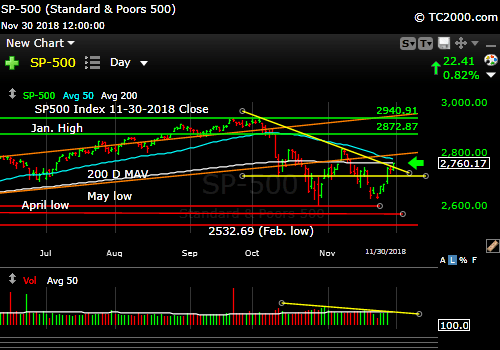
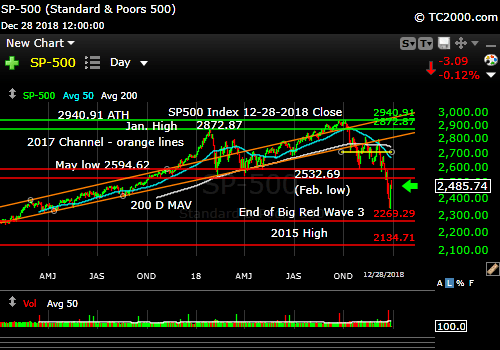
You’ll note in the chart below that the SP500 Index bounce this week came very close to the February low and then turned down.  That by itself is a negative.  Moving back above the Feb. low on strong buying is a key move the SP500 Index has to complete to turn this bounce into a 1X bounce into a 2X or more bounce.  XLK (Tech Sector of SPX) did rise above that Feb. low breakdown level, but not by much.  If you see XLK failing on Monday, it could spell bad news for the Bulls.  On the other hand, if the XLK rally simply continues, it could auger good things for January at least. 

SP500 Large Cap Index (click chart to enlarge; SPX, SPY):
sp500-index-spx-market-timing-chart-2018-12-28-close

Bouncing in a Bear Market.

Survey Says!  Sentiment of individual investors (AAII.com) showed a Bull minus Bear percentage spread of -18.75% vs. -22.44% the prior week.  The poll ended Weds. night and there are too many Bulls still.  Sentiment suggests the bottoming process is not complete or the bottom has still not been reached.   I would ask, “How can the market bottom without truly negative sentiment numbers given this is one of the worst Decembers ever?”  You can read my comment in my StockTwits markettiming room HERE.

AAII.Com Individual Investor Sentiment Poll
Bulls Neutrals Bears
31.55% 18.15% 50.30%
Thurs. 12 am CT close to poll

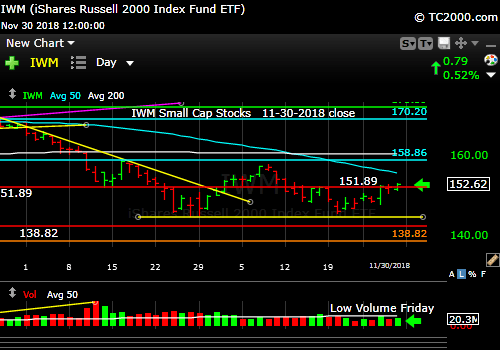
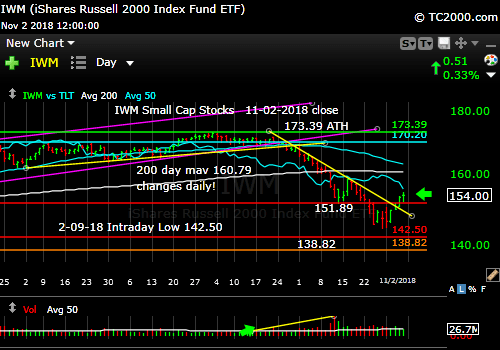
2.  U.S. Small Caps Market Timing (IWM):  Not a good place to be until signs of U.S. economic acceleration appear or are anticipated.  Still far below the February low and below that orange line which was the second breakout to higher highs after the first post-2016 Election bounce.

Russell 2000 U.S. Small Cap Index  (click chart to enlarge; IWM, RUT):

iwm-russell-2000-market-timing-chart-2018-12-28-close

Still miles below the Feb. low.

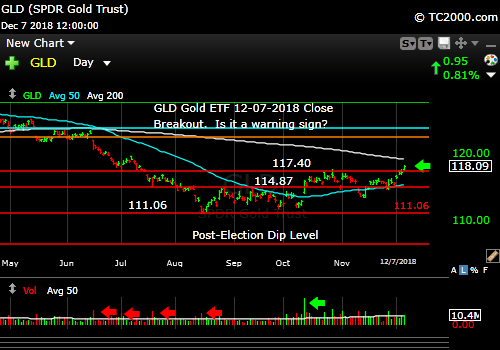
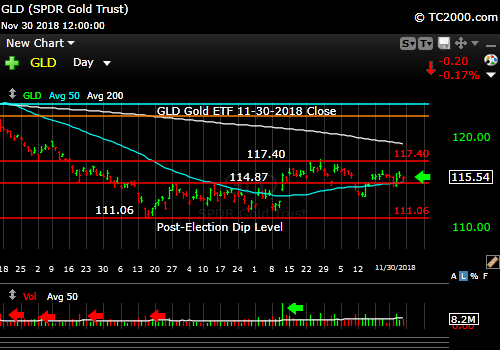
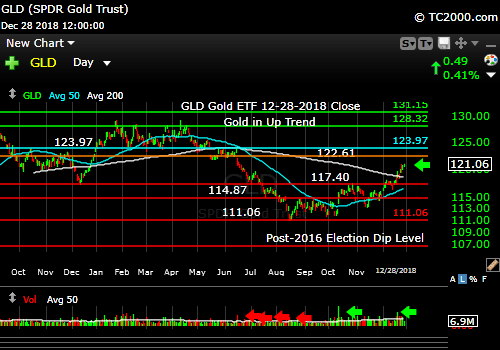
 3. Gold Market Timing (GLD):  Last week I said: “A trading add on pullbacks.”  The risk to gold is that interest rates rise somewhat from here and stocks continue their rally higher.  Note GLD pulled back during the big 5% SP500 rally on Weds. and then rose as the rally slowed its advance.  

The Gold ETF (click chart to enlarge the chart; GLD):
gld-gold-etf-market-timing-chart-2018-12-28-close

Gold moves up, but won’t continue up if rates rise from here.

4. Interest Rate Market Timing – U.S. 10 Year Treasury Note Yield (TNX):

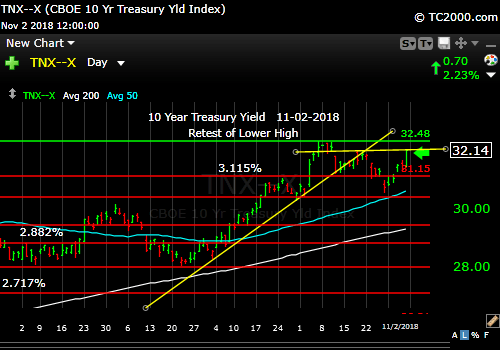
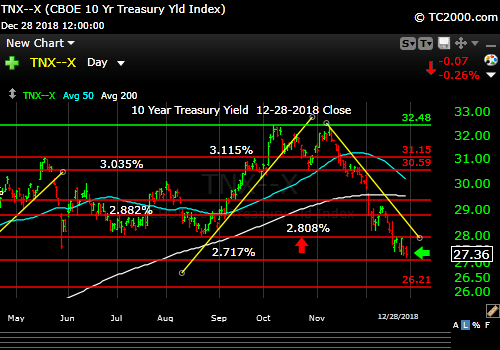
Still true from last week:T*N*X 2.808% is the key level to watch for a reversal back UP.”  (the *’s are there so bots cannot read my targets)

On an immediate basis, rates falling to new lows below the Friday close would spell trouble for the stock market rally, but I will be watching the simultaneous performance of stocks to interpret the meaning of the rate change.  If stocks sell off with rates moving down further, it would mean risk ON was back to OFF again. 

UPDATE 12-31-18: If rates fall slowly with stocks rising, that would mean the market feels the Fed will come it’s way and go slower on rate hikes and eventually reverse course.  T*N*X 2.717% is the last low of importance.   Watch what stocks do if that is breached and you’ll know what it portends, because the move already in motion will accelerate.  If stocks are falling as rates fall, they will keep falling.

Back to Sunday’s issue….

It’s not clear which way this will go, as rates got very close to my upside reversal number on Weds., but did not close above it.   Watch the 10 Year Yield closely for what I said in the room on Friday could mean “death to the current bounce.”  My number noted in the room has been “marked” by the market as I like to say. Exactly in fact!  It closed Friday exactly at the key number (noted in the same “room note” with the link in the “Sentiment” section above).

Check out the “Market Signal Summary” below – after you review the following chart…

U.S. 10 Year Treasury Note Yield (click chart to enlarge; TNX, IEF, TYX, TLT, TBF):
tnx-10-year-treasury-note-market-timing-chart-2018-12-28-close

If stocks are to continue higher, rates should not move down further on an immediate basis.

Now let’s review three key market timing signals together…. 

Do not use these signals as a trading plan.  They are rough guidelines.  I currently share my own moves on social media (links above).

MY MARKET SIGNAL AND TREND SUMMARY for a Further U.S. Stock Market Rally with Real GDP Growth (“Real” means above inflation):

Stock Signal RED for a further U.S. stock market rally with a BEARISH SP500 Index trend. (signal here is based on small caps)  There is just a bounce in a down trend thus far.  There is nothing technically that is terribly reassuring.

The V*IX (which relates to SPX volatility) closed at 28.34 which is still very Bearish.  It closed at 30.11 the prior week.  The V*IX did reclaim 28.84, which is positive, but must keep falling.

From prior week and other back issues: Further V*IX Bull Targets: 25.94, 23.81, 20.34, 18.18 to 18.10, 17.24, 16.86, and 15.95 to create a new recent low.   The ‘Bull Nirvana Target’ is our V*IX # of the Year: 13.31.”

Six weeks ago I said: “The Bears need to take out the 26ish top that was tested once again this week for the market to go into another leg of  decline.”

I said previously: “As before, VIX 28.84 is the Bear target for Armageddon (another big chunk of losses driving SPX down significantly lower).  Just moving above 26 could do it however.”

Gold Signal RED for a further U.S. stock market rally with a BULLISH Gold Trend.  A further rally will be subject to interest rates, which will impact the U.S. Dollar.  See GLD section above.

From before: “Remember GLD is being used as an indicator for the ECONOMY here.”

Rate Signal  RED  for a further stock market rally with a BEARISH 10 Year Yield Trend.  I said 2 weeks ago, “Watch the oil price too.  Higher oil tends to mean higher rates.”

As for much higher rates and their possible impact, I said previously:  “All heck would break loose for equities if TNX lurches above 3.248%, particularly if the rise is rapid.  Buy long dated Treasuries as close as you can to 3.248% on the 10 Year Yield TNX (IEF, TLT, etc.).” 

I previously warned about the Fed tightening process: “This level of the 10 Year Treasury Yield, which is too high for current conditions as explained HERE, will eventually slow the economy.”

Sept. 28th issue: “A rapid push higher in rates would mean trouble for stocks, as occurred in early 2018.  That’s what I call ‘Rate Shock.'”  The period of rising rates in early October was #RateShockII as I called it. 

Thank you for reading.  Would you please leave your comments below where it says “Leave a Reply”… or ask a question or report a typo… 

Pay it forward by sending the link to MarketTiming.Blog (that link will immediately connect them to this webpage) to a relative or friend.  Thanks for doing that.

Be sure to visit the website for more general investing knowledge at:

Sun and Storm Investing™

Standard Disclaimer: It’s your money and your decision as to how to invest it.

I thank Worden Brothers for the charting system I use to post these charts.  If you want to know more about the charting system I use every day, go HEREIt makes it much easier to follow along with me if you can see the charts and manipulate them on your own computer.  It’s a great investment to have an excellent charting system.  Check it out with a free trial at the link above.  I am an affiliate of Worden Brothers, though oddly I’ve never been paid a cent by them.  If you HAVE subscribed to their service, please send me a message. 😉

Note: I’ve updated my criteria for the equity signal for a further U.S. stock market rally to the following: GREEN = Bullish, YELLOW = Neutral, RED = Bearish.  In other words, the colors tell you whether the signal supports the stock rally or not, while the Bullish, Neutral, and Bearish designations are about the trend. 

A BEARISH trend signal does not mean we should not buy.  A BULLISH trend signal does not mean you cannot sell some exposure.  It depends on what is going on in the economy and how oversold/overbought the market is at a given point whether the Bearish signal is to be sold, sold on the next bounce, etc. and whether a Bullish signal is to be bought or if profits should be taken.  A NEUTRAL trend signal does not mean the end of the Bull or Bear. It means to wait and look for possible subsequent entry points within the existing trend, Bull or Bear, but preserve capital if the entry fails.  Our strong intention is to buy low and sell high.  By the way, I will keep showing the prior orange “Trigger lines” in the charts for now as reference points only; they have historical value for us from the post-2016 election period.

Copyright © 2018 By Wall Street Sun and Storm Report, LLC All rights reserved.

Posted in Bonds, gold, investment, investor sentiment, large cap stocks, S&P 500 Index, small cap stocks, Treasuries | Tagged , , , , , , , , , , , , , , , , , , , , , | Leave a comment

Market Timing Brief™ for the 12-21-2018 Close: A Mini Bear Market Begins for the S&P500 Index. Big Bear to Come? Gold in an Up Trend with U.S. Dollar Still Strong and Rates Still Below a Key Low.

A Market Timing Report based on the 12-21-2018 Close, published Sunday, December 23rd, 2018…

I deliver focused comments on market timing once a week.  These are supplemented with daily “Tweets/StockTwits” (see links below) and comments in the “markettiming” room on StockTwits.

1.  SP500 Index Market Timing (S&P 500 Index®; SPY, SPX):

I’ve noted there are many issues being faced by the weak market of late.  Let’s do a quick update of these and then get to the technical damage of the U.S. equity markets that occurred this week…

1. Data on holiday sales.  Bloomberg says that this past Saturday should have been a very strong day as the Christmas season has been thus far with sales on Dec. 22nd to exceed Black Friday sales as detailed HERE.  I am still concerned that this last push may be weaker than it could have been due to the poor stock market behavior of late.  There will be data on this in the coming week.  I’d say overall, retail sales are a plus for the market with that caveat of potential late December weakness.

2.  A Trump Xi Trade U.S. agreement with China within the 90 day period with the clock running since the G20 meeting.  The adminstration seems to have gotten the message from me and hopefully you and many others that they should talk less and work more and deliver a coherent message on their progress.   (Public officials respond to calls, emails, and letters more than the public understands.)

3. U.S. interest rates staying relatively low, but not breaking too low (which hurts financial stocks).  

I said 2 weeks ago: “Rates have moved down off the peak of 3.248% in the 10 Year Treasury Yield since Nov. 8th and now look ready to perhaps find support at the summer lows of around 2.80% and bounce.”  

That 2.80%ish number is now just above the current level of 2.792%.  It would be Bullish in the current technical context for rates to rise somewhat from here rather than fall further.  A further decline in rates would signal a deepening Bear market (it is already a “Mini Bear Market” in SP500 Index terms, thus far, as I’ll get to…)

Last week my Fed Rate Hike Handicapping included this choice:

3. If the Fed hikes 0.25% and does not make clear dovish overtures to the markets, the SP500 Index could move into the Big Red Wave.  The Federal Reserve Chair Powell made the #3 choice and failed to be sufficiently dovish for the U.S. stock market.  He set off a “Mini Bear Market” due to the Federal Reserve posture being the front and center issue for the stock market.  Trump’s shutdown of the government and his rising impeachment risk did not help either (see below). 

I did not position further ahead of the Fed, because no one can predict ignorance on the part of an organization (the Fed), which employs over 400 economists with your and my tax money.  The Fed gets some major credit for pushing the market over the edge this week, but Trump and the GOP get credit for tax cuts which drove inflationary pressures high enough for the Fed to need to start hiking rates.  Trump and the GOP got what they paid for through fiscal irresponsibility. 

4. GDP growth is slowing. Here is the key that Ray Dalio and others have figured out: It’s not the absolute level of GDP growth that matters most to stock prices; it is whether GDP growth is rising or falling that matters.  Hint: the same thing applies to individual stocks, so pay attention to that in your research on specific companies. 

The Fed focuses on GDP levels instead of GDP growth in their work and thought process.  They even say on paper they believe the long term growth potential for the economy is 1.8% Y/Y GDP growth.  They project growth will drop even lower than their prior 2.5% estimate for 2019 to 2.3% from 3.0% in 2018, but they are not adjusting their rate hike path meaningfully, given that degree of slowing.  They did lower their hike expectations from 3 to 2 for 2019 in their supplementary data provided with the FOMC statement, but that is still too aggressive for stock market investors.

I’ll tell you why the Fed looks confused to Jim Cramer and many other critics.  Their mandate is to maintain monetary policy to support full employment at a longer run level of 4.4% unemployment (per this week’s PDF) and low inflation at about 2% for the PCE Inflation Index (they most closely follow Core PCE inflation but don’t provide a “longer term” estimate of what it should be).

That means as long as employment is good and inflation is low, “All is well.”  They have no mandate from Congress to maintain the acceleration of GDP growth at a certain rate.  If they did have a “Three Mandate System,” of full employment, low inflation, and accelerating GDP growth, they would still be forced to fight inflation at a certain point to prevent the Fed from getting too far behind and creating a bigger recession.  That’s what they claim about the risk of uncontrolled inflation to steady long term economic growth.  They can no longer promote acceleration of the year over year (Y/Y) GDP level when they feel their focus must be on inflation to meet their dual employment/inflation mandates.   I’ve told you repeatedly over the past several issues that the Fed is now solely focused on inflation.  Yes, they have a dual mandate, but they can let unemployment rise and still meet their mandate per their definitions. 

Now we need to update the prior percentage drops in GDP that are expected by the Federal Reserve based on their published numbers this week:  The Fed’s own numbers say growth of GDP is supposed to slow substantially into 2019 when GDP will be a mere 2.3% (revised from 2.5%) vs. 3.0% (revised from 3.1%) in 2018 and by 2020 it will drop to 2.0% and then finally to their long run estimate of “longer run” growth of just 1.9% but not before dropping to 1.8% for 2021.  That’s a drop in GDP of  23.3% (revised from 19.4%) for 2019 and a drop of 33.3% (revised from 35.5%) for 2020 vs. 2018.  For 2021, the fall vs. 2018 GDP is 40%.  

Strategically, we have to remember this from last week: “This “global growth slowing” period is a slow multi-quarter event, but we can monitor the economic data and analyst projections to decide when to add back equity exposure from our current lower level. ”  However, until things change, I won’t change my stance, which is to sell more exposure higher to be sure my exposure level remains lower than usual (read my comments from last week HERE about how to think about adjusting your exposure under “What You Could Consider Doing”)

5. Oil staying low but not breaking to major new lows that would shut down drilling operations.  WTI Oil fell below 50 this week to about 45/barrel, which can begin to shut down operations in the U.S. and increase unemployment.   Not helpful.  Lower oil cost is a benefit to the overall economy, but there are banking financial risks involved too.  Low is great.  Too low, not so great!

6. Stability among tech stocks would help.  Not happening.  There was a bad break there below the Feb. lows for XLK (Tech sector of SPX) and QQQ, -21.6% and -21.3% respectively.  Those breaches just happened on Friday.  The NASDAQ broke the Feb. low a day earlier and is -22.1% from its all time high (ATH).

7. Impeachment and possible Senate trial risk for President Trump.  Read last week’s update please.  Bottom line?  If Mueller has a lot of new information on Trump that raises his Senate Trial conviction risk, the stock market could move down another “chunk” to reach the Clinton level of drawdown as discussed previously HERE.  From this level, ejection of Trump from office could result in this “Mini Bear” market becoming a “Big Bear Market.” 

8. U.S. Government Shutdown on Dec. 21: I reviewed this last week (see link just above).  Bottom line?  Shutdowns don’t matter unless they are protracted.  And yet, it’s a problem the market really does not need so contact your Rep and two Senators using the links I provided last week and let them know they are not helping.   

Now let’s check in on two “Canary Signals” we’ve been following:

“Intel-igent Market Timing Signal” (Intel; INTC):  More Negative.  Fell this week into the prior down channel after a failed recovery.  Down about 22% from its ATH.

Only a rise above 50.60 would change the current picture of a down trend since the June high. (Reminder: INTC was/is our “tell” on 2nd half earnings in tech as noted HERE.)

Bank of America (BAC) Market Timing Signal:  Last week I said “Not Negative – Even More Horrendous than Negative.  It fell to brand new recent lows this week.  Financials broke the October low.”  The stock is now down over 29% from its ATH.  Points to a Bear market for stocks.  

What, No Santa?

I pointed out this week, December crashes through major support are virtually unheard of.  There is really only one that is even close and this December is worse.  An issue to consider for a Year 2000 analogy is that valuations were off the wall high back then and are not as bad now.  The thing to realize is that estimates can come down further and further as economic slowing snowballs around the world.  For now, a recession is not predicted with high confidence by any reasonable estimates I’ve seen, so I’m still in the “Mini Bear Market” (a.k.a. “Cyclical Bear” Market) camp.   I call them “Mini Bears” because the economy does not slide into a recession, and stocks recover much faster, evening reaching new all time highs.  The economic and market trauma from a Mini Bear is much less than in a Big Bear Market; hence, it’s really “Mini” in proportion, even though the maximum decline of around 25% does not feel very good at all.  How you feel does not matter.  How you respond matters.

A great example of a Mini Bear Market was that of the Clinton Impeachment period.  Another would be the 2011 Mini Bear Market.  Those declines were over 20% but there was no recession in either case. 

From last week: “December 2000: In December there was a swoon below major support and the year ended “on the edge.”  There was a bounce but the year did not end above support and 2001 was even worse after a short rally as I described HERE in my StockTwits Market Timing Room.  Remember that 2001 was a continuation of a massive Bear market for the SP500, but even more so for tech stocks that went down 78% from the highs.”

Will this be the first time since 1970 (which was as far back as I looked) that the market crashes through obvious support and just keeps falling?

The odds said no, but Friday was the 3rd close below major support for all remaining holdouts.  The SP500 Index fits that as does XLK (Tech) and QQQ (heavy on Big Tech).  The SP500 Index entered a “Mini Bear Market” in loss terms on Thursday and broke lower by another 2.06% on Friday.

What’s my new “Big Red Wave” target?  I posted it as an update to the prior post with that title HERE.   Please read that update…  It is critical.

We will get a rally, but when?  Tax loss selling could continue the cascade into the 28th, the last trading day of the year.  Read my comments in the room regularly.  I won’t repeat everything here and there are some useful comments I think, because the room allows me to expand on my thinking to a point of greater clarity. That’s the goal.  Let me know how much you like the room by leaving comments in the room if you have not.  Thanks. The room link is just below here…

WARNING: There will be fake bounces.  I called out one within 2 minutes of the fake bounce top on Friday after the market reacted positively to Fed Gov. Williams saying about the same thing Powell said.  A bunch of blowhards (to put it nicely) got on TV, and said Williams was saying something different.  He did not.  Don’t fall for these fakes!  Selling the bounce was the thing to do and certainly the right thing was NOT buying it!

Another fake bounce this week would be a government shutdown reversal.  Whatever magnitude bounce that yields, which cannot happen until Dec. 27th will be a SELLING opportunity in my view.  As said above and last week, shutdown reversals are NOT a Bullish catalyst. 

Keep up-to-date during the week at Twitter and StockTwits (links below) where a combined 33,802 investors are following the markets with me…

Follow Me on Twitter®  Follow Me on StockTwits®.

Join the Conversation in the StockTwits “markettiming” Room

SP500 Large Cap Index (click chart to enlarge; SPX, SPY):

sp500-index-spx-market-timing-chart-2018-12-21-close

Big Red Wave continues.

Survey Says!  Sentiment of individual investors (AAII.com) showed a Bull minus Bear percentage spread of -22.44% from -27.97% the prior week.  The fact the percentage of Bulls increased into the Weds. poll closing after the market tanked was completely the wrong way to think and a contrary indicator!  The spread is going to have to hit 30 or so unless the market bottoms and rockets before we can see the shift in investor sentiment.  The polls don’t always capture what has happened as they are done once a week.  Investors are still trying too hard to “believe” in the market.

AAII.Com Individual Investor Sentiment Poll
Bulls Neutrals Bears
24.86% 27.84% 47.30%
Thurs. 12 am CT close to poll

2.  U.S. Small Caps Market Timing (IWM): Covered this for weeks and warned to sell high volatility stocks, which includes IWM.  They are in a cascading crash.

Russell 2000 U.S. Small Cap Index  (click chart to enlarge; IWM, RUT):

iwm-russell-2000-market-timing-chart-2018-12-21-close

Cascading crash.

 3. Gold Market Timing (GLD):  A trading add on pullbacks.  Because I believe rates may move up with the dollar in the near term, gold could pull back until that rate bounce is over.  If stocks move up, rates will too.  If stocks keep sliding straight down, rates will keep falling.  Follow the dance if you are trading GLD.

The Gold ETF (click chart to enlarge the chart; GLD):

gld-gold-etf-market-timing-chart-2018-12-21-close

Gold in an up trend for now. Buy pullbacks.

4. Interest Rate Market Timing – U.S. 10 Year Treasury Note Yield (TNX):

Rates are UP slightly after Powell and I believe that could continue for at least a bounce.  But that will depend on stocks as just mentioned in the GLD section.   T*N*X 2.808% is the key level to watch for a reversal back UP.  (the *’s are there so bots cannot read my targets)

Check out the “Market Signal Summary” below – after you review the following chart…

U.S. 10 Year Treasury Note Yield (click chart to enlarge; TNX, IEF, TYX, TLT, TBF):

tnx-10-year-treasury-note-market-timing-chart-2018-12-21-close

Time for a little bounce?

Now let’s review three key market timing signals together…. 

Do not use these signals as a trading plan.  They are rough guidelines.  I currently share my own moves on social media (links above).

MY MARKET SIGNAL AND TREND SUMMARY for a Further U.S. Stock Market Rally with Real GDP Growth (“Real” means above inflation):

Stock Signal RED for a further U.S. stock market rally with a BEARISH SP500 Index trend. (signal here is based on small caps)

The VIX (which relates to SPX volatility) closed at 30.11 which is off the wall high for a close!  Volatility took off to the upside on Monday and kept climbing on Thurs. and Fri.  It closed at 21.23 the prior week.  The VIX must reclaim 28.84 now and keep falling.  It could simply explode to 50 in the next move, so be careful.  I said last week “rising above 23.81, which would embolden the Bears in a big way.”  It did. 

Further V*IX Bull Targets: 25.94, 23.81, 20.34, 18.18 to 18.10, 17.24, 16.86, and 15.95 to create a new recent low.   The ‘Bull Nirvana Target’ is our V*IX # of the Year: 13.31.”

Six weeks ago I said: “The Bears need to take out the 26ish top that was tested once again this week for the market to go into another leg of  decline.”

I also said previously for weeks: “As before, VIX 28.84 is the Bear target for Armageddon (another big chunk of losses driving SPX down significantly lower).  Just moving above 26 could do it however.”  Yup, it did.

Gold Signal RED for a further U.S. stock market rally with a BULLISH Gold Trend.  It rose back above the prior consolidation band.  See GLD section above.

From before: “Remember GLD is being used as an indicator for the ECONOMY here.” 

Rate Signal  RED  for a further stock market rally with a BEARISH 10 Year Yield Trend.  The trend is still down despite the potential now for a bit of a bounce. I said last week, “Watch the oil price too.  Higher oil tends to mean higher rates.”  Oil collapsed to new lows this week.

As for much higher rates and their possible impact, I said previously:  “All heck would break loose for equities if TNX lurches above 3.248%, particularly if the rise is rapid.  You buy long dated Treasuries as close as you can to 3.248% on the 10 Year Yield TNX (IEF, TLT, etc.).” 

I previously warned about the Fed tightening process: “This level of the 10 Year Treasury Yield, which is too high for current conditions as explained HERE, will eventually slow the economy.”

Sept. 28th issue: “A rapid push higher in rates would mean trouble for stocks, as occurred in early 2018.  That’s what I call ‘Rate Shock.'”  The period of rising rates in early October was #RateShockII as I called it. 

Thank you for reading.  Would you please leave your comments below where it says “Leave a Reply”… or ask a question or report a typo… 

Pay it forward by sending the link to MarketTiming.Blog (that link will immediately connect them to this webpage) to a relative or friend.  Thanks for doing that.

Be sure to visit the website for more general investing knowledge at:

Sun and Storm Investing™

Standard Disclaimer: It’s your money and your decision as to how to invest it.

I thank Worden Brothers for the charting system I use to post these charts.  If you want to know more about the charting system I use every day, go HEREIt makes it much easier to follow along with me if you can see the charts and manipulate them on your own computer.  It’s a great investment to have an excellent charting system.  Check it out with a free trial at the link above.  I am an affiliate of Worden Brothers, though oddly I’ve never been paid a cent by them.  If you HAVE subscribed to their service, please send me a message. 😉

Note: I’ve updated my criteria for the equity signal for a further U.S. stock market rally to the following: GREEN = Bullish, YELLOW = Neutral, RED = Bearish.  In other words, the colors tell you whether the signal supports the stock rally or not, while the Bullish, Neutral, and Bearish designations are about the trend. 

A BEARISH trend signal does not mean we should not buy.  A BULLISH trend signal does not mean you cannot sell some exposure.  It depends on what is going on in the economy and how oversold/overbought the market is at a given point whether the Bearish signal is to be sold, sold on the next bounce, etc. and whether a Bullish signal is to be bought or if profits should be taken.  A NEUTRAL trend signal does not mean the end of the Bull or Bear. It means to wait and look for possible subsequent entry points within the existing trend, Bull or Bear, but preserve capital if the entry fails.  Our strong intention is to buy low and sell high.  By the way, I will keep showing the prior orange “Trigger lines” in the charts for now as reference points only; they have historical value for us from the post-2016 election period.

Copyright © 2018 By Wall Street Sun and Storm Report, LLC All rights reserved.

Posted in Bonds, gold, investment, investor sentiment, large cap stocks, S&P 500 Index, small cap stocks, Treasuries | Tagged , , , , , , , , , , , , , , , , , , , | Leave a comment

Market Timing Brief™ for the 12-14-2018 Close: Will the S&P500 Index Bounce in December or Not? Gold Sags as Rates Begin a Bounce.

A Market Timing Report based on the 12-014-2018 Close, published Saturday, December 15th, 2018…

I deliver focused comments on market timing once a week.  These are supplemented with daily “Tweets/StockTwits” (see links below).

1.  SP500 Index Market Timing (S&P 500 Index®; SPY, SPX):

There are a lot of issues being faced by the weak market we’re experiencing.  I count eight key issues.   

1. Data on holiday sales.  Data from aerial surveys of malls look decent per a report aired on CNBC, and U.S. retail sales were still OK in the last reading on Friday.  As it stands, the Federal Reserve is “messing with Christmas” by continuing their stance of hiking into global economic slowing.  Not smart!  Many retail businesses do the vast majority of their sales in the 4th Quarter.

2.  A Trump Xi Trade U.S. agreement with China within the 90 day period with the clock running since the G20 meeting.

China lifted some auto tariffs that are not that important numerically, but it was at least one positive in a sea of confusion.  At least things did not become even worse this week.  It would be great if the purveyors of contradiction in the Trump administration could simply close their traps! They did quiet down finally – let’s hope they stay silent unless they have positives to share in ONE VOICE!

3. U.S. interest rates staying relatively low, but not breaking too low (which hurts financial stocks).  

I said last week: “Rates have moved down off the peak of 3.248% in the 10 Year Treasury Yield since Nov. 8th and now look ready to perhaps find support at the summer lows of around 2.80% and bounce.”

That’s about what they did.  Rates bounced from 2.825% on Monday.

If rates drop to new lows below 2.80% or so, it will likely be paired with U.S. equity markets hitting fresh new lows.

What will the Fed do on December 19th at the end of their next FOMC meeting?  This week the CME Group says the market is now only 76.6% sure vs. 71.5% sure last week that the Fed will hike 0.25%, whereas it was above 90% previously.  A significant number of investors could find themselves “offsides,” as 23.4% of the market will be disappointed by a hike in December! 

Volatility around the next rate decision is likely, given the percentage of potentially off-sides investors reflected in these odds.   

As last week, I believe the market would rally on “no hike in December,” because it will be the clearest recognition that the Fed recognizes the slowing in the global economy is now impacting the U.S. and “going slower” on hikes would be better than risk adding a further drag on the economy.

Here is my full handicapping of the possible results of the FOMC Meeting ending Dec. 19th:

1. If the Fed does nothing (leaves rates unchanged) the market could rally based on their “finally getting it,” that the entire world is now in a growth slowing phase.  The greatest bounce in stocks would occur on this news IMO.

2. If the Fed hikes 0.25% and says it will likely pause or something that is clearly dovish, the market could bounce as well, perhaps not as much.

3. If the Fed hikes 0.25% and does not make clear dovish overtures to the markets, the SP500 Index could move into the Big Red Wave.

4. If the Fed lowers rates by 0.25%, the market could collapse further in a vote of no confidence, because it would mean the Fed was more worried about the economy than many market players are.   There is an upside risk with this choice of course as there is a common belief that you should not “fight the Fed.” I believe it would be temporary, however.

4. GDP growth is slowing.  A reminder:  “The Fed’s own numbers say growth of GDP is supposed to slow substantially into 2019 when GDP will be a mere 2.5% vs. 3.1% this year and by 2020 it will drop to 2.0% and then finally to their long run estimate of ‘longer run’ growth of just 1.8% by 2021.  That’s a drop in GDP of 19.4% for 2019 and a drop of 35.5% for 2020 vs. 2018!” 

This is the item that is very tough to shift, especially with the Federal Reserve hiking into slowing.  If that changes, it will help.  The other thing that will help is for the business cycle to reassert itself to the upside, something that could take several quarters without an additional fiscal stimulus such as infrastructure.

Should we spend more money we don’t have at a time when the deficit is already being blown out by Trump and the GOP with tax cuts?  The deficit this year is running 17% higher than last year.  Many Republicans will vote against a large infrastructure package or further tax cuts at this point, unless they have really lost their fiscal minds.

Bottom line?  This “global growth slowing” period is a slow multi-quarter event, but we can monitor the economic data and analyst projections to decide when to add back equity exposure from our current lower level. 

5. Oil staying low but not breaking to major new lows that would shut down drilling operations.  Between OPEC cuts and robust U.S. production, the price of oil has languished near $50.  It would help the market if oil prices stayed above $50 in jobs and financial stability terms.

6. Stability among tech stocks would help.  Tech has been a bad sector for investors since the Sept. high in general terms.  Stick with the exceptions, but be careful not to give back all your profits.  XLK, the tech spider ETF, is testing near the higher April 2018 low.

If you are ahead 30% for example and allow a 10% loss from that, and then say, “Well it will probably bounce” and it then goes to a loss of half of the gain, meaning to a 15% gain, and then you say, “Well, it must bounce now,” and it then drops to a 5% gain…you get the picture.   Decide on how much of your gains you are willing to give up and then stick to that number. 

Sometimes paying taxes is cheaper than allowing your entire profit to dissolve away to nothing.  Rebuying a stock higher is cheaper than if you “sell low.”

7. Impeachment and possible Senate trial risk for President Trump.  Michael Cohen’s story is going to be corroborated, it seems, by David Pecker’s story in implicating President Trump in at least two crimes involving campaign finance laws.  Yes, they are crimes despite the disinformation spewed by Trump claiming they were not crimes.  Sometimes he is simply off the wall ridiculous in his outright lies to the public.

As I said on social media this week, our President appears to be a criminal.   That’s a new event in evidence terms.  This raises the risk of impeachment and another further drop in the stock market in my view.  He does not have to be convicted by the GOP controlled Senate for the markets to drop substantially more.  To prepare yourself, review, if you have not already done so, my Post on the Clinton Impeachment Market Decline.

I’ll stand by this from last week: The market would react even more negatively to Trump’s removal from office through a Senate conviction, but that is unlikely if there was no collusion with Russia.  And yet, even after an additional decline, the market would then recover as Pence = Trump more or less. 

8. U.S. Government Shutdown on Dec. 21: Remember that under Trump, the government shut down briefly from Jan. 20-21 2017, and a funding gap occurred the first part of the day of Jan. 9th of this year.  Reagan had three shutdowns lasting a day or less. Clinton had two lasting five and 21 days.  Obama had one lasting sixteen days in Oct. 2013 over funding of Obamacare (ACA). 

Shutdowns are not the end of the world, but the market certainly does not need this aggravation during the busiest shopping period of the year.  This is something Trump can easily compromise on with the Democrats, and he will be blamed for it, if it happens.  He even said he’d accept the responsibility for it! 

I suggest you contact the President and your House Rep.  and two Senators via these links to urge them NOT to shut down our government: House and Senate In many cases, you can simply leave a message with your comment or opt in to speaking with a staff member to leave your opinion.  They do respond to public input.  Send tweets to @POTUS and @WhiteHouse as well. 

Now let’s check in on two “Canary Signals” we’ve been following:

“Intel-igent Market Timing Signal” (Intel; INTC):  Negative, but now outperforming the SP500 Index.  After rising in late October, it has been consolidating, while the SP500 Index has fallen lower.

Still, only a rise above 50.60 would change the current picture of a down trend since the June high. (Reminder: INTC was/is our “tell” on 2nd half earnings in tech as noted HERE.)

Bank of America (BAC) Market Timing Signal:  Not Negative – Even More Horrendous than Negative.  It fell to brand new recent lows this week.  Financials broke the October low.  This adds major risk to the overall market, which is why a rise of rates back up toward 3% would actually be welcome by the overall market (and hated by interest rate sensitive stocks like housing) as long as it does not occur too quickly. 

There is a flurry of technical analysis this weekend trying to discern where the current market fall will stop.  I’ve told you before, that’s a fool’s game.  You have to handicap the future performance of company earnings and revenues, decide whether that is impacted by various policies and the above list of 8 issues the market faces, consider the rest of the world and its trajectory, etc. etc. etc.

I’ve shared with you the “secret” that you cannot possibly pick a “target” based on valuation, because markets often go higher AND lower than they should based on valuation, and furthermore, slowing can beget more slowing as we’ve seen as Ex-US slowing has infected the U.S. economy that most everyone believes is headed lower in GDP growth terms.  That means whatever the analysts come up with today, they’ll have to downgrade in three months with the next set of analyst earnings projections.

What You Could Consider Doing

You may not sell until the next bounce or next breach of the SP500 Index for example, but it’s never too late for YOUR money to make strategic decisions and lay out your plan on paper or in a file!  It will help you think more clearly to write it down or type it up!

  1. Lower your exposure and protect profits as close to what appear at the time to be highs in the market as slowing growth kicks in. That’s what I’ve been doing repeatedly at each market top.  I coined the term “Passive Shorting” for this and you can read about it HERE.  And then I add back exposure on the lows to play bounces, but in between I would suggest you also began to …
  2. Lower your “Top Level of Exposure During a Correction/Bear Market” (the SP500 Index is NOT yet one by my “New Rules“), while still playing bounces.  You would optimally lower your exposure level at the tops or just off them, on a breach of trend for example.  In other words, instead of going from 100% exposure at the top to 80% exposure and moving back to 100% exposure at a perceived bottom, you add back only 10% perhaps moving to 90% exposure as your “Top Level of Exposure,” during a correction until conditions change (the economy accelerates for example).

    I’m now at roughly 72.5% exposure vs. the exposure I would normally hold during a solid Bull market. 
    I’ve been adding near the current low, having sold exposure at the last high on 12-03, but not raising my exposure level back to 100% certainly until conditions change.  Yes, sometimes I sell or buy exactly when I should as on Dec. 3rd.  At other times I’m off by a day or two or more.  Back near the first 2015 low in the SP500 Index, one of my buys was off by 2 days and another was off by 3 days.  The market fell to yet another lower level on a breach during Flash Crash II in August 2015.  I bought again even closer to the early 2016 low, but not at the low.

    The key is this: you don’t have to buy the exact low to profit from a decline, as the U.S. market, in the end, goes up, not down as its major trend, at least until the United States ceases to be the world’s leading economy. 
    (It’s no wonder Trump wants us to have a level playing field with China.  On that, I agree with him.)

    Individual stocks go down, yes, and dramatically so, and even disappear from the indexes,
    as GE has shown investors, regardless of the prior long term reputation of the company.GE is now down about 58% YTD.  It’s out of the Dow but still in the SP500.  Eventually it could be broken up and sold off into companies too small to be included in the SP500.  This tells you indexes are in a way still “managed,” because they have to dump the losers when they fail to meet the criteria for the index any longer.

Let’s review where the markets are relative to the start of a Possible Big Red Wave as I’ve called it…

  1. The SP500 Index must hold the 10-29-18 intraday low or thereabouts.  Remember, tests of levels often exceed them, and if the test is successful, a bounce ensues.  For SPY, that is 259.85.  For SPX it’s 2532.69.  For SPX, the close was 2599.95 vs. the May low of 2594.62 and the Oct. low of 2603.54 and the Feb. low of 2532.69.  To join the small and mid caps, the SPX would have to fall another 2.59% just to reach the Feb. low, which is why everyone is looking at, no staring at, these May and February lows “hoping” one of them will hold, because…
  2. Midcaps (IJH), which I said must hold the Oct. low, essentially at the  February low, are now broken.  The February low was 1770.19 and we’re at 1732.81 at Friday’s close.  The Midcap index is -2.12% vs. the Feb. low.  And misery loves company, so…
  3. Small Caps which I said must hold the February low, which they were barely above as of last Friday’s close are now BELOW that low of 1436.43 for the Russell 2000 Index (RUT) or 142.50 for IWM.  The closes were 1410.81 and 140.61, respectively.  The RUT is now 1.79% BELOW the Feb. low and IWM is 1.33% below its low.

    If the small and mid caps are in fact leading the way as they did at the start of this downdraft, the Big Red Wave may be about to start for the SP500 Index,
    because it’s begun for the small and mid caps.The optimistic view would be that small and mid caps are higher risk, so they are testing lower than the SP500 Index, which will save the day by holding the February low.

    Without a positive catalyst or preferably the alleviation of more than one of the current issues listed above that are facing the markets, the market could simply continue lower.The Federal Reserve statement at 2 pm Weds. and the dog and pony show at 2:30 pm could be such a catalyst.

  4. Gold: I said last week gold must pull back as rates rise again with the dollar starting Monday.  I also said the financials should be helped by that and they were not, which is a problem for the market.  However, my prediction held.  Dollar was up, rates are off the lows, and gold has eased a bit.

If positive catalysts can be conjured up by the Trump trade team, no government shutdown, and a dovish Fed, the market could bounce from here.  Two of those could be enough.  The Fed alone could be enough to delay the next sell-off to 2019.  I reviewed the possible “Bounce Levels” HERE (scroll down and you’ll see the list) previously.

If the SP500 Index breaks support and follows the breaches by both small and mid caps this week, the “Big Red Wave” I described three weeks ago HERE could begin.  That would drive massive buying of  U.S. Treasuries, driving rates down even further.  What will I do in that case?  I will be lowering my exposure to no more than 60% of my usual maximum equity exposure for a Bull market worldwise if the SP500 Index decends into the Big Red Wave.  I may do it in steps to avoid being whiplashed by a 1-2 day breach of the lows as happened before.

I pointed out this week, December crashes through major support are virtually unheard of.  But maybe Trump can make things even worse than he has and create the first such December crash since 1970.  I went back to there and found two instances in which:

  1. December 1973: There was a test in Dec. of the 1971 low that succeeded followed by another major decline in 1974.  However, we were in recession from 1973-1975, which is not the case now.  We cannot assume a January 2019 rout.  In any case, the rout did not come in December!
  2. December 2000: In December there was a swoon below major support and the year ended “on the edge.”  There was a bounce but the year did not end above support and 2001 was even worse after a short rally as I described HERE in my StockTwits Market Timing Room.  Remember that 2001 was a continuation of a massive Bear market for the SP500, but even more so for tech stocks that went down 78% from the highs.

Will this be the first time since 1970 (which was as far as I looked) that the market crashes through obvious support and just keeps falling?

The odds say no, but as I said in the room, it could be different this time, and in 2019 if there are weak Q4 numbers and projections reported in February the market may go over the edge.

Keep up-to-date during the week at Twitter and StockTwits (links below) where a combined 33,802 investors are following the markets with me…

Follow Me on Twitter®  Follow Me on StockTwits®.

SP500 Large Cap Index (click chart to enlarge; SPX, SPY):

sp500-index-spx-market-timing-chart-2018-12-14-close

Will it hold the February low or descend into the “Big Red Wave”?

Survey Says!  Sentiment of individual investors (AAII.com) showed a Bull minus Bear percentage spread of -27.97% vs. +7.44% the prior week.  There has finally been enough of a washout of Bullish sentiment to allow for a bounce.  But sentiment has room to be even more negative.  It says the SP500 Index could hold February support is the best I can say.  Not reassuring, again, without distinct positive catalysts like the Fed being clearly dovish.

AAII.Com Individual Investor Sentiment Poll
Bulls Neutrals Bears
20.90% 30.23% 48.87%
Thurs. 12 am CT close to poll

2.  U.S. Small Caps Market Timing (IWM):  I covered the key points above.  Not a place to add unless you are just averaging in blindly.

Russell 2000 U.S. Small Cap Index  (click chart to enlarge; IWM, RUT):

iwm-russell-2000-market-timing-chart-2018-12-14-close

A Broken Chart

 3. Gold Market Timing (GLD):  I said last week: “So for the very short term, I’ll wait to add more GLD.”  That was correct.  I have no gold trades on for now.  Just insurance (I’d suggest 5% of investable assets as most do; remember gold yields zero and makes us paper money only when rising!  If you own none, average in over time or buy the lows and sell the highs if you like.).  I have to see more strength and wait for rates to retop out to buy back into a trading GLD position. 

The Gold ETF (click chart to enlarge the chart; GLD):

gld-gold-etf-market-timing-chart-2018-12-14-close

Gold slipping on higher rates and higher dollar.

4. Interest Rate Market Timing – U.S. 10 Year Treasury Note Yield (TNX):

Two weeks ago I said:  “If they [rates] continue to fall as the stock market rises, beware!  That’s not how it is supposed to work in a recovery.  It means the recovery is false.  It means the stock bounce will be limited.” 

I said last week:  It’s critical that rates bounce early next week, preferable on Monday.  

They bounced on Monday and should continue higher UNLESS the Fed turns more dovish on Weds and especially if they don’t hike (not likely per CME Group – see above).

Check out the “Market Signal Summary” below – after you review the following chart…

U.S. 10 Year Treasury Note Yield (click chart to enlarge; TNX, IEF, TYX, TLT, TBF):  (Ignore the caption saying “Lower Still. Ready to bounce?” – it did bounce higher!)

tnx-10-year-treasury-note-market-timing-chart-2018-12-14-close

Rates reach a prior low and bounce on cue.

Now let’s review three key market timing signals together…. 

Do not use these signals as a trading plan.  They are rough guidelines.  I currently share my own moves on social media (links above).

MY MARKET SIGNAL AND TREND SUMMARY for a Further U.S. Stock Market Rally with Real GDP Growth (“Real” means above inflation):

RED RED RED this week. 

Stock Signal RED for a further U.S. stock market rally with a BEARISH SP500 Index trend. (The Signal here is based on the small caps, and I’m sure you know their trend is also Bearish!)

The VIX (which relates to SPX volatility) closed at 21.23 this week vs. 23.23 last week , which remains Bearish.  The trend is still UP and That is still a high VIX.  The VIX did reclaim 22.97 and must avoid rising above 23.81, which would embolden the Bears in a big way.  The close Friday was below the up trend line of VIX (now at 22.88).  These numbers change daily.  The next Bear target above 23.81 is 25.94.   

Further VIX Bull Targets: 20.34, 18.18 to 18.10, 17.24, 16.86, and 15.95 to create a new recent low.   The ‘Bull Nirvana Target’ is our VIX # of the Year: 13.31.”

Five weeks ago I said: “The Bears need to take out the 26ish top that was tested once again this week for the market to go into another leg of  decline.  If they do it soon, it COULD still just last a day or two.”  The last test of that was on 12-06 at 25.94.

As before, VIX 28.84 is the Bear target for Armageddon (another big chunk of losses driving SPX down significantly lower).  Just moving above 26 could do it however.

Gold Signal YELLOW for a further U.S. stock market rally with a NEUTRAL Gold Trend.  It has slipped back into the prior consolidation band.  That’s a near term negative.  See above for more.  A gold rally, if strong, would be a sign of global financial panic if seen with a strongly rising US dollar.

From before: “Remember GLD is being used as an indicator for the ECONOMY here.” 

Rate Signal  RED  for a further stock market rally with a BEARISH 10 Year Yield Trend.  The trend is still down despite the bounce.  Watch the oil price too.  Higher oil tends to mean higher rates.

As for much higher rates and their possible impact, I said previously:  “All heck would break loose for equities if TNX lurches above 3.248%, particularly if the rise is rapid.  You buy long dated Treasuries as close as you can to 3.248% on the 10 Year Yield TNX (IEF, TLT, etc.).” 

I previously warned about the Fed tightening process: “This level of the 10 Year Treasury Yield, which is too high for current conditions as explained HERE, will eventually slow the economy.”

Sept. 28th issue: “A rapid push higher in rates would mean trouble for stocks, as occurred in early 2018.  That’s what I call ‘Rate Shock.'”  The period of rising rates in early October was #RateShockII as I called it. 

Thank you for reading.  Would you please leave your comments below where it says “Leave a Reply”… or ask a question or report a typo… 

Pay it forward by sending the link to MarketTiming.Blog (that link will immediately connect them to this webpage) to a relative or friend.  Thanks for doing that.

Be sure to visit the website for more general investing knowledge at:

Sun and Storm Investing™

Standard Disclaimer: It’s your money and your decision as to how to invest it.

I thank Worden Brothers for the charting system I use to post these charts.  If you want to know more about the charting system I use every day, go HEREIt makes it much easier to follow along with me if you can see the charts and manipulate them on your own computer.  It’s a great investment to have an excellent charting system.  Check it out with a free trial at the link above.  I am an affiliate of Worden Brothers, though oddly I’ve never been paid a cent by them.  If you HAVE subscribed to their service, please send me a message. 😉

Note: I’ve updated my criteria for the equity signal for a further U.S. stock market rally to the following: GREEN = Bullish, YELLOW = Neutral, RED = Bearish.  In other words, the colors tell you whether the signal supports the stock rally or not, while the Bullish, Neutral, and Bearish designations are about the trend. 

A BEARISH trend signal does not mean we should not buy.  A BULLISH trend signal does not mean you cannot sell some exposure.  It depends on what is going on in the economy and how oversold/overbought the market is at a given point whether the Bearish signal is to be sold, sold on the next bounce, etc. and whether a Bullish signal is to be bought or if profits should be taken.  A NEUTRAL trend signal does not mean the end of the Bull or Bear. It means to wait and look for possible subsequent entry points within the existing trend, Bull or Bear, but preserve capital if the entry fails.  Our strong intention is to buy low and sell high.  By the way, I will keep showing the prior orange “Trigger lines” in the charts for now as reference points only; they have historical value for us from the post-2016 election period.

Copyright © 2018 By Wall Street Sun and Storm Report, LLC All rights reserved.

Posted in Bonds, gold, investment, investor sentiment, large cap stocks, S&P 500 Index, small cap stocks, Treasuries | Tagged , , , , , , , , , , , , , , , , , | Leave a comment

Market Timing Brief™ for the 12-07-2018 Close: These 3 Levels Must Hold for Stocks. The “China Trade Clown Act” Continues. Rates Skid and Gold Rallies, Both Cautionary Signals.

A Market Timing Report based on the 12-07-2018 Close, published Saturday, December 8th, 2018…

I deliver focused comments on market timing once a week.  These are supplemented with daily “Tweets/StockTwits” (see links below).

1.  SP500 Index Market Timing (S&P 500 Index®; SPY, SPX):

Two weeks ago I said we need to avoid the “Big Red Wave…”

Let’s review the key challenges that could lead the market down even further or help buoy the market if they work out well.  This week we have the resurgence of a lingering risk, now rising in magnitude, for Trump’s impeachment and less likely expulsion from his post.

1. “Data indicating stronger than expected holiday sales would help.”  Consumer sentiment is still near all time highs, so the shopping season is not a problem unless the market downdraft has shoppers holding back already.  I don’t think that is yet the case, but the volatility around the holidays certainly does not help at the margin, when many businesses do the vast majority of their business during the Christmas buying season.  I’ll give this point a check with some concern over high ticket sales coming through as expected.

2. “A Trump Xi agreement with China to avoid 25% tariffs, or better yet, an even more comprehensive agreement within the 90 day period with the clock running since the G20 meeting.  Friday, the Trump administration said they could allow for an extension if needed and if progress was being made on coming to an agreement.

The contradictions between Larry Kudlow and Peter Navarro became absurd this past week.  The administration needs to speak with one voice.  Trump has said he likes chaos, and this certainly fits that pattern.  The market very clearly despises chaos of any kind.  Send @POTUS a note on Twitter to speak with one voice in the administration!  He once called Senator Schumer a “clown.”  I evaluate Trump by each thing he does, good or bad.  What is going on now in this administration is a “China Trade Clown Act” at best!  They need to get a grip and stop the confusion ASAP.

It was reported that President Trump was becoming concerned that he, not Powell, was responsible for the market going down.  He considers it his “economic report card,” and the grade for 2018 is a C minus at best with the S&P 500 Index off 10.34% from the intraday high on 9-21-18 and -1.52% since 12-29-17 (YTD).   He’s not helping the market for sure, but remember the underlying slowing of growth in the economy (not negative growth, a slowing of the rate of growth) is the more important driver of the stock market downturn in my view.  It is always the primary driver behind all the day to day drama, which generates all the up and down volatility.

Nevertheless, trade wars and trade war confusion certainly can make things worse by raising prices as the Fed seeks to control inflation as their primary goal for the first time since the Great Recession.  Powell is faced with raising rates to control the component of inflation that is due to the trade war.  Powell is oddly “lucky” that the economy is slowing while this trade war is being conducted, which takes pressure off to raise rates as fast as would be otherwise needed.

No check mark on trade!

By the way, I update my market strategy frequently in our Market Timing Room HERE.   There is no charge at this time, and you do not have to post any comments if you prefer not to.  I suggest you follow me on Twitter as well as on StockTwits as we have had occasional outages on the latter platform of late, in which case I continue to communicate with you on Twitter HERE.

3. U.S. interest rates staying relatively low, but not breaking too low (which hurts financial stocks) would help.  As I’ve said, Powell merely indicated in his speech to the New York Economics Club that Fed rates are “just below the broad range of estimates of the level that would be neutral for the economy.” 

Chair Powell threw them one bone: Rates MAY be near the lower end of the range of what will serve as a neutral rate.  The market was looking for a bone, so it reacted positively to that generating the bounce last Wednesday, which has since dissolved away entirely!  More concerning to me was Powell’s continued claim that he and “many private sector economists” are expecting “solid growth” in the U.S. economy in 2019.  Solid? 

I’ll remind you of what I said last week: “I’ve covered this is prior posts, but the Fed’s own numbers say growth of GDP is supposed to slow substantially into 2019 when GDP will be a mere 2.5% vs. 3.1% this year and by 2020 it will drop to 2.0% and then finally to their long run estimate of “longer run” growth of just 1.8% by 2021.  That’s a drop in GDP of 19.4% for 2019 and a drop of 35.5% for 2020 vs. 2018!” 

Bottom line?  Rates have moved down off the peak of 3.248% in the 10 Year Treasury Yield since Nov. 8th and now look ready to perhaps find support at the summer lows of around 2.80% and bounce.  They won’t bounce if we move into the “Big Red Wave” I described two weeks ago HERE.  That will drive massive buying of Treasuries, driving rates down even further.

What will the Fed do on December 19th at the end of their next FOMC meeting?  The CME Group says the market is now only 71.5% sure the Fed will hike 0.25%, whereas it was above 90% previously.  For January, there is a 69.2% probability the Fed will hike, but some of those market participants reflected in that number are from the “no hike in December” group no doubt.  There is only a 27.1% probability of TWO hikes by March, which is at the previously assumed pace of Fed hiking, which was one hike of 0.25% in December and one in March. 

Those probabilities set up some issues for the market.  1. About 30% of the market is going to be disappointed by a hike in December!  Others like Jim Cramer are assuming a near 100% probability they will hike and say the market would fall apart if they don’t.  Do you see the problem developing?  Volatility around the next few rate decisions is highly likely given the percentage of disappointed investors reflected in these odds.   

Then you arrive at the interpretation of the rate hike as good or bad.  Is it “bad” if the Fed does not hike?  Jim Cramer claimed the market would fall apart without a hike, because it portends bad things for the economy.  I don’t buy this.

I believe the market would rally on “no hike in December,” because it will be the clearest recognition that the Fed recognizes the slowing in the global economy is now impacting the U.S. and “going slower” on hikes would be better than risk adding a further drag on the economy and potentially flipping a number of S&P 500 companies into junk bond status, something the Fed has their eye on we are told. The Fed’s FIRST obligation is defending the stability of the financial system including the banks. 

I do not believe the market will fall apart given a December hike, as it’s the favored result, but I admit there could be some initial selling around the decision. 

4. Oil staying low but not breaking to major new lows that would shut down drilling operations would help. 

OPEC and Russia together cut production by 1.2 Billion barrels per reports.  Oil did not exactly shoot up in elation after the dust settled, so the jury is still out.  Oil below $50 brings risk to oil company debt.  Oil “gets a check” with a need to hold the $50ish low.

5. Stability among tech stocks would help.  No check there.  Tech unlike the SP500 Index is testing its November low, not the higher October low still in play for the S&P.

6. Impeachment and possible Senate trial risk for President Trump.  Given the revelations about Trump’s “fixer” and lawyer Michael Cohen on Friday night, the President is likely to be charged with a crime in some fashion.  The Justice Department has made it clear they find no legal basis for indicting a sitting President, but this issue could be taken to the courts and would likely end up in the Supreme Court, where Trump has the majority in his favor.  The crime could be taken up by the Democratic House in January and serve as the basis of impeachment (we are assuming there was no collusion with Russia, the risk of which was raised by the Cohen filings by the Southern District of New York (the “Billions Office” by the way) and the Special Counsels Office (Mueller)). 

If impeachment comes down to the crimes of paying off a Playboy bunny and a porn star, even if it involved a campaign finance violation, I believe it’s highly unlikely a trial to remove President Trump would succeed.  He could potentially argue he was just trying to keep the cheating from Melania as some have suggested.  The Senate, controlled by the GOP, would conduct the trial at which a 2/3 super-majority of votes is required to remove the President from office.  That is highly unlikely to happen unless it can be proven that Russia colluded with Trump directly in breaking into Podesta’s/Clinton’s emails for example.  Then he would be out without question.

The other issue is the hotel Trump wanted to build in Russia.  IF he made overt promises to the Russians on ending sanctions in order to build a Trump Moscow Tower, he could be out as well, but whether that is actually criminal in nature is not clear.  I suspect it is, but claim no legal expertise on the matter.  In any case, it seems treasonous if true and would provide a reason for his defeat in a Republican primary battle.

Bottom Line on Impeachment/Trial: It’s become more probable now that Trump will be impeached by the Democrat controlled House.  Impeachment over lying alone brought the market down followed by a bounce in Bill Clinton’s case as many of you have read. Here’s that Post on the Clinton Impeachment Market Decline. You can see there what the additional risk could be for the market.  It’s a big further drop!

The market would react even more negatively to Trump’s removal from office through a Senate conviction, but that is unlikely if there was no collusion with Russia.  The market would then recover as Pence = Trump more or less.  If there was DIRECT and obvious collusion by Trump, then even GOP Senators Marco Rubio and Cruz would be forced to convict Trump, and they’d be joined by other Republicans.  Trump would be out on the street.  But for now, that is all conjecture, so we cannot assign more than a very low risk to the “removal of Trump” scenario.

The market is already on thin ice.  We are at a technical level that if violated, could drive further selling and send us into the “Big Red Wave.” The ice often holds when it has to, but Powell is NOT a “put on a bigger market decline.”

If you don’t like the “ifs” in the market, you may want to do something other than follow the markets, because handicapping “ifs” is the nature of the beast.  If oil can drop from $75 to $50 from Oct. 3rd to Nov. 23rd, how can you hold the current picture as anything other than that of “Master Market,” the 5 year old temper tantrum throwing child who is equally elated 10 minutes later?

The market game is more like blackjack.  You can beat the house, but not if you don’t control your risk and seize opportunity when you see it.

Controlling your risk means lowering your exposure when growth of the economy is slowing and seizing opportunity means buying when markets are down despite the fear, even if your overall exposure is lower.  I share my exposure level to equities with you online on social media (links below just above the first chart), which I have not seen anyone else do.  They don’t want to be held accountable.  My exposure level gives you a feel for how much risk I perceive in the market.  Adjust it to your taste, age, and circumstances or ignore it if you disagree.  And take responsibility for your decision.  You are the one who must be able to sleep at night with your decisions.

If the market bounces, is a review of the possible “Bounce Levels” HERE (scroll down and you’ll see the list).

Remember this guideline on this level and any other level of the market: We can only assess the way the market behaves at any given market level and decide whether the market is stretched to the upside or stretched to the downside.  Then we add back exposure at the putative lows and remove some at the putative highs.  That is the process I coined the term “Passive Shorting” for and it has been working!  Read about it HERE

Now let’s check in on two “Canary Signals” we’ve been following:

“Intel-igent Market Timing Signal” (Intel; INTC):  Negative.  Intel turned down about where I thought it would.  It now continues to slide down the upper line that forms the down channel it’s in on the daily chart. Only a rise above 50.60 (two closes is safest, but you could attempt to enter sooner with a stop) would change the current picture of a down trend since the June high. (Reminder: INTC was/is our “tell” on 2nd half earnings in tech as noted HERE.  We are now closing in on the end of the 4th quarter.)

Bank of America (BAC) Market Timing Signal:  Not Negative – Horrendous.  BAC outdid the XLF financial Spider ETF this week, which held just above the October low, much like the SP500 Index is doing by the way.  BAC cut to a brand new low, below the October low, which is ominous for a bank of this importance.  It must recover quickly or the market will be more likely to descend into the “Big Red Wave.”  (see link above)

Key Break Points to Avoid the “Big Red Wave” this Week:

  1. The SP500 Index must hold the 10-29-18 intraday low or thereabouts.  Remember, tests of levels often exceed them, and if the test is successful, a bounce ensues.
  2. Midcaps (IJH) must hold the Oct. low, which was essentially at the level of the February low.  The low on Friday was barely above that low.  The close was barely above the low for Friday.  We’re that close to breaking the ice.
  3. Small Caps must hold the February low, which they are barely above as of Friday’s close.
  4. Gold must pull back as rates rise again with the dollar starting Monday.  If the moves are the opposite of that, there will be more trouble for stocks.  Financials (this time XLF, not just the canary BAC as noted above) will be breaking to new lows and dragging the market down with it.

You see the picture?  Mid and small caps are already testing the Feb. lows, while the SP500 Index is testing the October low which lies above the Feb. low.  A swoon of the SP500 Index to the February low would bring it 3.81% lower than the Friday close.

Right now the small caps have descended into what I refer to in percentage terms as a Mini Bear Market as defined HERE (scroll to “New Rules”). The losses off the top are now 16.94% for IWM, just above the 15% threshold of my definition.  Yes, any drawdown up to 25% would potentially be “OK” and perhaps lead to even higher highs for the market, but if IWM breaks the support mentioned above the next downturn could take it as low as another 6.88% (to 134ish) or to a total decline of 22.65%, approaching the low end of a “Big Bear Market,” as I call a Secular Bear Market. They are the markets of recessions, not drawdowns in a still rising market.  “Mini Bear Markets” are the latter.

On December 3rd I told you I sold a “chunk” of midcap exposure.  The prior Saturday I asked: “Where is the most obvious place for the stock market to turn down?  Right at or slightly above the 50 day mav just as with Bank of America.  Notice how it did exactly that once before in November…”

You’ll notice on the chart below that selling the rally on Monday on the false China trade hope was perfect timing.  I don’t always buy at the exact bottom or sell at the exact top, but I’m often within a day or two of major moves.  It’s very hard to catch every move precisely, as I’m sure you well know.  But market timing can be done better than is realized by many.  Knock knock….as they say…there but for the grace of God go I.  I wake up and do my best every day and seek to improve every single day.  That’s all we can ask of ourselves.  Do your best and leave the rest is the saying…

I raised my exposure by around 4% (vs. 100% of max exposure) since I dropped it near the Dec. 3rd bounce high.  This is just one place the market could hold.  There are no guarantees that the iffy points  noted above are going to clear and allow the market to rise, even in a bounce.  The new closing low in the small caps on Friday, despite being above the Feb. intraday low, is still of concern for risk of more downside. 

If I see any of the 3 indexes noted just above breaking down further in the coming week, I will consider dropping my exposure by 5-15%.  For reference, I would guess 60% of usual maximum exposure for a Bull market is the lowest I will go.  There is risk of being out of the market as I related in the “Big Red Wave” post, but there is also risk of lost opportunity.  So I’ll stand by my recent buying of this particular low, but I reserve the right to ditch all that and more if this low does not hold.

I bought SPY and some stocks that are doing better than the overall market, all noted on my feeds on social media.  Do your own due diligence on them.  I analyze markets and I do not claim to be a stock analyst, unlike some marginal self-proclaimed pundits on TV.  Beware of following their advice.  Although I do analyze stocks to some extent to satisfy certain criteria, I don’t publish that work.

Stick to the index ETFs if you don’t have the time or inclination to do your own research.  My saying I bought stock A should not be enough for you to buy it.  That would be ridiculous in my view.  You need to go over the data on any stock yourself, listen to at least the last earnings call or two for the stock and look at the technical chart set-up.  That would be the minimum.  Also realize that you take on more risk and opportunity by holding individual stocks.  Balance risk/opportunity in your decisions.

Keep up-to-date during the week at Twitter and StockTwits (links below) where a combined 33,802 investors are following the markets with me…

Follow Me on Twitter®  Follow Me on StockTwits®.

SP500 Large Cap Index (click chart to enlarge; SPX, SPY):

sp500-index-spx-market-timing-chart-2018-12-07-close

A Market On Thin Ice

Survey Says!  Sentiment of individual investors (AAII.com) showed a Bull minus Bear percentage spread of +7.44% vs -5.59% the prior week.  Get this: Individual investors became MORE Bullish after the Tuesday 3.24% drop in the SP500 Index!  The market promptly dropped another 2.89% the next market day (Thurs.) after GHW Bush’s funeral services.  It then bounced and closed down only another 0.15% for the day.  Then it fell to Friday’s close, dropping 2.75% vs Thursday’s close.

There still has been not a strong washout of Bullish sentiment from the market.  This by itself is a negative. 

AAII.Com Individual Investor Sentiment Poll
Bulls Neutrals Bears
37.94% 31.56% 30.50%
Thurs. 12 am CT close to poll

2.  U.S. Small Caps Market Timing (IWM):  I covered the key points above.  Both being on thin technical ice and a close at a new closing low vs. the Feb. low is negative.  A breach of the Feb. low by small caps would be taken very badly by the overall market unless it was quickly reversed, preferably during the same day as the breach.

Russell 2000 U.S. Small Cap Index  (click chart to enlarge; IWM, RUT):

iwm-russell-2000-market-timing-chart-2018-12-07-close

Testing a new closing low vs. the Feb. low.

 3. Gold Market Timing (GLD):  Gold has finally rallied, just as rates appear ready to bounce.  If rates do NOT bounce as mentioned, the stock market will be doing much worse and gold may benefit along with the U.S. dollar due to financial panic.  You see, gold goes UP with the dollar when there is financial panic, even if it’s ex-US, but the U.S. is also now subject to panic selling of equities.  If rates plunge again next week, gold will continue to rally.  I consider it a buy for insurance, but NOT for a trade from this level, because I expect rates to move up from here and the dollar up with it.  So for the very short term, I’ll wait to add more GLD.

The Gold ETF (click chart to enlarge the chart; GLD):

gld-gold-etf-market-timing-chart-2018-12-07-close

Gold could be a warning sign for stocks, especially if it keeps rising next week.

4. Interest Rate Market Timing – U.S. 10 Year Treasury Note Yield (TNX):

Last week I said:  “If they [rates] continue to fall as the stock market rises, beware!  That’s not how it is supposed to work in a recovery.  It means the recovery is false.  It means the stock bounce will be limited.” 

My warning on a continued rate decline is noted above.  It’s critical that rates bounce early next week, preferable on Monday. 

Check out the “Market Signal Summary” below – after you review the following chart…

U.S. 10 Year Treasury Note Yield (click chart to enlarge; TNX, IEF, TYX, TLT, TBF):

tnx-10-year-treasury-note-market-timing-chart-2018-12-07-close

Rates falling fast this week crushed financial stocks.

Now let’s review three key market timing signals together…. 

And just below, I have a “Bonus Chart” this week…

Do not use these signals as a trading plan.  They are rough guidelines.  I currently share my own moves on social media (links above).

MY MARKET SIGNAL AND TREND SUMMARY for a Further U.S. Stock Market Rally with Real GDP Growth (“Real” means above inflation):

RED RED RED this week.  Lots of RED.

Stock Signal RED for a further U.S. stock market rally with a BEARISH SP500 Index trend. (The Signal here is based on the small caps, and I’m sure you know their trend is also Bearish!)

The VIX (which relates to SPX volatility) closed at 23.23 this week , which remains Bearish.  But that is still a high VIX.  The VIX will need to reclaim 22.97 first and avoid rising above 23.81, which would embolden the Bears in a big way.  Next stop for the Bulls below 22.97 would be the VIX up trend line at about 22.54 (as of Fri. close).  These numbers change daily.  The next Bear target above 23.81 is 25.94 again.   

Further VIX Bull Targets: 17.24, 16.86, and 15.94 to create a new recent low.   The ‘Bull Nirvana Target’ is our VIX # of the Year: 13.31.”

Four weeks ago I said: “The Bears need to take out the 26ish top that was tested once again this week for the market to  go into another leg of  decline.  If they do it soon, it COULD still just last a day or two.”  The high this week?  It was 25.94.  Close!

As before, VIX 28.84 is the Bear target for Armageddon (another big chunk of losses driving SPX down significantly lower).

Gold Signal RED for a further U.S. stock market rally with a BULLISH Gold Trend.  See above for more.  If the rally persists, it will be a negative signal for stocks in the near term.

From before: “Remember GLD is being used as an indicator for the ECONOMY here.” 

Rate Signal  RED  for a further stock market rally with a BEARISH 10 Year Yield Trend.  The trend is still down.  If oil cooperates and moves up a bit, rates could rise again early next week.  New lows below that red line just below the current level would be negative for stocks.

As for much higher rates and their possible impact, I said previously:  “All heck would break loose for equities if TNX lurches above 3.248%, particularly if the rise is rapid.  You buy long dated Treasuries as close as you can to 3.248% on the 10 Year Yield TNX (IEF, TLT, etc.).” 

I previously warned about the Fed tightening process: “This level of the 10 Year Treasury Yield, which is too high for current conditions as explained HERE, will eventually slow the economy.”

Sept. 28th issue: “A rapid push higher in rates would mean trouble for stocks, as occurred in early 2018.  That’s what I call ‘Rate Shock.'”  The period of rising rates in early October was #RateShockII as I called it. 

Thank you for reading.  Would you please leave your comments below where it says “Leave a Reply”… or ask a question or report a typo… 

Pay it forward by sending the link to MarketTiming.Blog (that link will immediately connect them to this webpage) to a relative or friend.  Thanks for doing that.

Be sure to visit the website for more general investing knowledge at:

Sun and Storm Investing™

Standard Disclaimer: It’s your money and your decision as to how to invest it.

I thank Worden Brothers for the charting system I use to post these charts.  If you want to know more about the charting system I use every day, go HEREIt makes it much easier to follow along with me if you can see the charts and manipulate them on your own computer.  It’s a great investment to have an excellent charting system.  Check it out with a free trial at the link above.  I am an affiliate of Worden Brothers, though oddly I’ve never been paid a cent by them.  If you HAVE subscribed to their service, please send me a message. 😉

Note: I’ve updated my criteria for the equity signal for a further U.S. stock market rally to the following: GREEN = Bullish, YELLOW = Neutral, RED = Bearish.  In other words, the colors tell you whether the signal supports the stock rally or not, while the Bullish, Neutral, and Bearish designations are about the trend. 

A BEARISH trend signal does not mean we should not buy.  A BULLISH trend signal does not mean you cannot sell some exposure.  It depends on what is going on in the economy and how oversold/overbought the market is at a given point whether the Bearish signal is to be sold, sold on the next bounce, etc. and whether a Bullish signal is to be bought or if profits should be taken.  A NEUTRAL trend signal does not mean the end of the Bull or Bear. It means to wait and look for possible subsequent entry points within the existing trend, Bull or Bear, but preserve capital if the entry fails.  Our strong intention is to buy low and sell high.  By the way, I will keep showing the prior orange “Trigger lines” in the charts for now as reference points only; they have historical value for us from the post-2016 election period.

Copyright © 2018 By Wall Street Sun and Storm Report, LLC All rights reserved.

Posted in Bonds, gold, investment, investor sentiment, large cap stocks, S&P 500 Index, small cap stocks, Treasuries | Tagged , , , , , , , , , , , , , , , , , | Leave a comment

Market Timing Brief™ for the 11-30-2018 Close: “Is This Just a Bounce in a Big Correction or More? 10 Year Treasury Yield Falls Further on Powell Remarks and Gold Stagnates.”

A Market Timing Report based on the 11-30-2018 Close, published Saturday, December 1st, 2018…

I deliver focused comments on market timing once a week.  These are supplemented with daily “Tweets/StockTwits” (see links below).

1.  SP500 Index Market Timing (S&P 500 Index®; SPY, SPX):

We need to check up on whether we can “Avoid the Big Red Wave…”

Last week I discussed what could avert a further big fall in the market and those comments are in quotes and in blue…

1. “Data indicating stronger than expected holiday sales would help.”  Sales were strong for the entire Black Friday weekend and Cyber Monday.  The other proof is stocks like Macy’s (M), Kohls (KSS), Walmart (WMT), and Amazon (AMZN) stocks were all up for the week.

As far as a decent shopping season goes, so far we have a “check.”   The consumer is in a good position because of 1) lower unemployment and 2) the tax cuts, so this will likely continue.

2. “A Trump Xi agreement with China to avoid 25% tariffs, or better yet, an even more comprehensive agreement at the G20 on Nov. 30-Dec. 1, would help.”  This one is pending a Saturday night meeting between Trump and Xi at dinner.  Trump sewed confusion, whether intentionally or not, by saying he was both close to an agreement and that he might not want one, because he likes the tariff revenues coming in from China.  He said both in one day! 

I will write a brief note on social media (links below) when we know more, but there’s no clear check mark for trade with China until Saturday night’s dinner.  Then we can gauge the market reaction from Sunday night futures.

I also have updated remarks about the rise in the market on Monday December 3rd HERE.  It is my private “Market Timing Room.”  You likely will have to join StockTwits to access these remarks, but you do not have to post any comments if you prefer not to.

3. Part A: U.S. interest rates staying relatively low, but not breaking too low (which hurts financial stocks) would help.  The 10 year Treasury yield moved lower after comments in a speech by Powell at the New York Economic Club on Wednesday, when he said:

“Interest rates are still low by historical standards, and they remain just below the broad range of estimates of the level that would be neutral for the economy‑‑that is, neither speeding up nor slowing down growth. My FOMC colleagues and I, as well as many private-sector economists, are forecasting continued solid growth, low unemployment, and inflation near 2 percent.”

Let’s digest that.  He said Fed rates are “just below the broad range of estimates of the level that would be neutral for the economy.”

That gives him tremendous latitude to hike or not hike, so unless he firms up on his bias toward “not hiking,” we won’t know until he and other members of the FOMC Committee decide.  In early October, per CNBC Powell said of the Fed, “We’re a long way from neutral at this point, probably.”

So which is it?  I believe he was throwing the market a bone, because in the end he does not know if the Fed will hike in early 2019 or not.  If he had not fallen back from the “long way” rhetoric, he risked fueling a further downturn in stocks, which does not make consumers who own stocks feel wealthy.  People who feel they have become poorer often don’t feel as happy about big expenditures.  Powell knows retail depends on a Merry Christmas selling season.

But Powell also said he and “many private sector economists” are expecting “solid growth” in the U.S. economy in 2019.  Solid?  I’ve covered this is prior posts, but the Fed’s own numbers say growth of GDP is supposed to slow substantially into 2019 when GDP will be a mere 2.5% vs. 3.1% this year and by 2020 it will drop to 2.0% and then finally to their long run estimate of “longer run” growth of just 1.8% by 2021.  That’s a drop in GDP of 19.4% for 2019 and a drop of 35.5% for 2020 vs. 2018! 

Powell and the Fed don’t believe the U.S. economy is supposed to be growing above 1.8% in the long run.  Maybe it’s realistic and true, or maybe it is not, but one thing is for sure – GROWTH IS NOT GOING TO BE SOLID for the next few years! 

There’s a disequilibrium between Trump’s view of “solid growth” of GDP, which is 3-4% and Powell’s view of it, which is 1.8%.  This means Trump may attempt to further stimulate the economy by various means, including an infrastructure bill he passes with Democrat help.  The Fed will then be put in a position of having to slow growth to avoid inflation due to a further fall in unemployment with corresponding wage hikes.  The Federal Reserve is responsible to its Congressional mandate of maximum employment with inflation of roughly 2% per year.  It cannot simply give Trump and his collaborators a pass.

Trump and the GOP passed their tax cuts and the Fed has kept raising rates through this period, which tends to work against Trump’s vision of higher growth.  That’s why he’s “not happy” with his choice of Jay Powell as Federal Reserve Chair!

Bottom line?  Rates have moved down off the peak of 3.248% in the 10 Year Treasury Yield since Nov. 8th, so that’s a “check.”

Part B: “The Fed could turn to being marginally move dovish…” I stated Powell did not do this, not really.  If you call NOT repeating “we are a long way from a neutral rate” dovish, then it was dovish. 

I think Powell is letting the market think what it wants.  He will hike and hike again as the data requires him to or not.  All he did was give up on defending a set interest rate as “neutral.”  He reiterated that they are on no “preset course,” and we may or may not be close to the neutral rate, but he really has no clue!  This idea that he truly said anything new is nonsense in my view. 

The market’s misconception is that Powell shifted to more dovish, so we’ll give that a skeptical “check.”  The proof is in the “NOT hiking” come January and March.  If the economy continues to slow in the U.S., they won’t be able to hike. They will be led by the economy and the Treasury market.

4. Oil staying low but not breaking to major new lows that would shut down drilling operations would help.  We saw MBS of Saudi Arabia high fiving Putin, so you can guess the oil cartel will figure out how to prop up oil prices.  It runs both their countries and now has a big impact on U.S. employment, so Trump is involved.  There could be both indirect and direct pressure on the Saudis to keep oil prices low, but not too low.  Trump seemed to be celebrating the oil crash as good for the economy, but it won’t be good if banks blow up, and our U.S. sourced supply becomes less economical as a result and is shut down with associated job losses.

Oil is now languishing just above $50, so there is no guarantee other than the happy oil pumpers at the G20 to reassure us that “they’ve got this.”  So no check for oil.

5. Stability among tech stocks would help.  Tech stocks rose this week, and even Apple’s stock did, though not as nicely as the QQQ for example.  Although the tech heavy QQQ was above its 10-11-18 low, XLK closed at 67.94 below the 10-11 low at 68.07.  If you see a rise above there Monday, it would be more convincing that tech was fully joining this rally.  Otherwise this is the end of a sizable bounce.

“Check” with an expectation of follow through Monday or else!

So what’s the Report Card on the 5 points above? 

3 of 5 are checks with one of those a skeptical check and another a “to-be-proven” check, so not great, but possibly passable for a further leg of this bounce.  You can review the possible “Bounce Levels” HERE (scroll down and you’ll see the list)No one can tell you how high the market can bounce.  If they’re sure, they’re lying.  

We can only assess the way the market behaves at any given market level and decide whether the market is stretched to the upside or stretched to the downside.  That process itself is not foolproof as we’ve seen markets that were very overbought just keep rising and those that were very oversold just keep falling. 

During overly Bullish run ups in stocks and indexes, we sometimes just have to hang on and let the market rise, or set tighter stops to protect profits on such a meteoric rise.  During a cascading fall by a stock or the market, we may sometimes buy at a lower levels and hold paper losses for a while, and at other times, raise more cash by taking profits during the first part of the fall, or limiting losses by quickly selling new buys that fall into the red, and then waiting for the air to clear.

I have lowered my exposure a bit going into this weekend, which may prove unsuccessful if Trump gooses the market again with a quasi win on China trade.  My exposure level can be accessed at the social media links below…

Now let’s check in on two “Canary Signals” we’ve been following:

“Intel-igent Market Timing Signal” (Intel; INTC):  Negative. Intel bounced from the 50 day moving averages (mav), which is positive, but has to get over the 200 day mav to convince me the trend has changed.  It will have to scale the highs from late August to November to get there.  For now, this is a robust bounce in an ongoing correction (it’s a Bear market for specific stocks, but not for the S&P 500 or even the worst performers, the small caps).  (Reminder: INTC was/is our “tell” on 2nd half earnings in tech as noted HERE.  We are now well into the 4th quarter.)

Bank of America (BAC) Market Timing Signal: Negative.  Financials including BAC rose with the S&P 500 Index this week, but stopped barely above the 50 day mav.  They did so as interest rates (10 Yr Yield) FELL.  That’s not how it’s supposed to work.  Banks depend on higher rates to improve their numbers, so the rise to just above the 50 day mav has to be assumed to be a bounce in an ongoing correction.

This is a classic pattern for an ongoing correction (potentially turning into a Mini Bear market as defined HERE (scroll to “New Rules”).  The market rises to or slightly above the 50 day mav and then falls again.  Investors are sucked into thinking “it’s over now,” and down the market goes.  If you hold such a stock, you could stay with it long enough to see if it moves up or down from a key pivot like this and act accordingly. 

Look at where the SP500 sits now in the chart below.  You can see it’s above that yellow down trend line, but just below the 200 day and 50 day mav’s.  It is farther below the orange line that represents the lower 2017 up channel line.  If this correction is not over, the market must fail at one of these spots.  Remember the last failure was from an all time high, so the market could rise even as far as the January high (or less likely to the all time Sept. high) and fail.

The reason I expect the correction is not yet over is because the economic picture is not one of rising earnings and revenue growth.  I’ve said since early August that growth is NOT enough.  You must have accelerating growth to send stocks up appreciably.  Until that is at least predicted by analysts, there won’t be a basis for bidding stocks back to the all time highs.

That is, unless the economy is goosed there by external forces as was the case with the Trump tax cuts.  The cuts created a 17% increase in the deficit over the prior year.  That is NOT “paying for itself,” which is the B.S. promise of what I call “Tinkle Down Economics.”  But President Trump did goose the economy and that goosed the stock market while creating even more national debt, something he campaigned against!  Ever since Reagan, both parties have spent money we don’t have year after year with no exceptions (Google “The Invention of Fiscal Lying” to find the post. Even with Bill Clinton’s “surplus,” they used Social Security to pretend there was a surplus.) 

President Trump is running out of tricks now other than infrastructure, and furthermore,  the GOP may oppose it when they consider the deficit they’ve created through their fiscal irresponsibility.

Where is the most obvious place for the stock market to turn down?  Right at or slightly above the 50 day mav just as with Bank of America.  Notice how it did exactly that once before in November…

Keep up-to-date during the week at Twitter and StockTwits (links below) where a combined 33,738 investors are following the markets with me…

Follow Me on Twitter®  Follow Me on StockTwits®.

SP500 Large Cap Index (click chart to enlarge; SPX, SPY):

sp500-index-spx-market-timing-chart-2018-11-30-close

No Big Bear Market ahead or a Fake-out Bounce?

Survey Says!  Sentiment of individual investors (AAII.com) showed a Bull minus Bear percentage spread of -5.59% vs. -21.89% the prior week.  We never got to a wash out level of sentiment, and there is room for more upside at this point as well as downside.  Sentiment is not that helpful when we’re in the middle like this.

AAII.Com Individual Investor Sentiment Poll
Bulls Neutrals Bears
33.88% 26.64% 39.47%
Thurs. 12 am CT close to poll

2.  U.S. Small Caps Market Timing (IWM):  The small caps bounced just above that red line shown in the chart, which is the 10-11 low.  That’s a positive, but I would have preferred to see a higher high than that of 11-29 (152.74).  The 50 day mav is nearby, just above…. The comments above on where markets commonly fail apply here too!  The 50 day mav or here for that matter would be a great place for IWM to fail.

Russell 2000 U.S. Small Cap Index  (click chart to enlarge; IWM, RUT):

iwm-russell-2000-market-timing-chart-2018-11-30-close

Close above my trigger point of the 10-11 low, but not by much.

 3. Gold Market Timing (GLD):  Gold has hesitated to rally this week despite rates falling again after Powell’s comments.  That’s a negative.

The Gold ETF (click chart to enlarge the chart; GLD):

gld-gold-etf-market-timing-chart-2018-11-30-close

Hesitating to rally.

4. Interest Rate Market Timing – U.S. 10 Year Treasury Note Yield (TNX):

Rates moved down further after Powell’s comments.  If they continue to fall as the stock market rises, beware!  That’s not how it is supposed to work in a recovery.  It means the recovery is false.  It means the stock bounce will be limited. 

Check out the “Market Signal Summary” below – after you review the following chart…

U.S. 10 Year Treasury Note Yield (click chart to enlarge; TNX, IEF, TYX, TLT, TBF):

tnx-10-year-treasury-note-market-timing-chart-2018-11-30-close

Powell’s speech sent rates lower.

Now let’s review three key market timing signals together…. 

And just below, I have a “Bonus Chart” this week…

Do not use these signals as a trading plan.  They are rough guidelines.  I currently share my own moves on social media (links above).

MY MARKET SIGNAL AND TREND SUMMARY for a Further U.S. Stock Market Rally with Real GDP Growth (“Real” means above inflation):

Stock Signal RED for a further U.S. stock market rally with a BEARISH SP500 Index trend. (The Signal here is based on the small caps, and I’m sure you can divine their trend is also Bearish!)

The VIX (which relates to SPX volatility) closed at 18.07, which was progress from the close last week at 21.52.  But that is still a high VIX.  The VIX cut below the bottom of the triangle shown in the chart last week, but it would have to drop below the 11-02 low of 18.05 to take the next Bullish step down, meaning Bullish for stocks (specifically the SP500 Index).

VIX Targets: The first step for the Bears is to retake the up trend line shown last week.  For the Bulls from prior issues are these additional targets: “The Bulls must first get through (drop below) 17.24 and then retake the 8-15 high of 16.86. The next step would be taking back 16.09 to create a new recent daily low.   The ‘Bull Nirvana Target’ is our VIX # of the Year: 13.31.”

Three weeks ago I said: “The Bears need to take out the 26ish top that was tested once again this week for the market to  go into another leg of  decline.  If they do it soon, it COULD still just last a day or two.” 

As before, VIX 28.84 is the Bear target for Armageddon (another big chunk of losses driving SPX down to the May lows or far lower).

Gold Signal NEUTRAL for a further U.S. stock market rally with a NEUTRAL Gold Trend.  Lower rates this week SHOULD have pushed gold up, so the gold market may be anticipating a rise in oil and a rise in rates soon.  As said, it needs to rally soon to avoid a fall back into the prior trading range. 

From before: “Remember GLD is being used as an indicator for the ECONOMY here.” 

Rate Signal  RED  for a further stock market rally with a BEARISH 10 Year Yield Trend.  The trend is still down.  It fell again after the Powell comments.  A China agreement could set off a risk on scenario where rates move up again for a bit.  Oil rising could do the same as said.

As for much higher rates and their possible impact, I said previously:  “All heck would break loose for equities if TNX lurches above 3.248%, particularly if the rise is rapid.  You buy long dated Treasuries as close as you can to 3.248% on the 10 Year Yield TNX (IEF, TLT, etc.).” 

I previously warned about the Fed tightening process: “This level of the 10 Year Treasury Yield, which is too high for current conditions as explained HERE, will eventually slow the economy.”

Sept. 28th issue: “A rapid push higher in rates would mean trouble for stocks, as occurred in early 2018.  That’s what I call ‘Rate Shock.’  This period of rising rates is #RateShockII.”

Thank you for reading.  Would you please leave your comments below where it says “Leave a Reply”… or ask a question or report a typo… 

Pay it forward by sending the link to MarketTiming.Blog (that link will immediately connect them to this webpage) to a relative or friend.  Thanks for doing that.

Be sure to visit the website for more general investing knowledge at:

Sun and Storm Investing™

Standard Disclaimer: It’s your money and your decision as to how to invest it.

I thank Worden Brothers for the charting system I use to post these charts.  If you want to know more about the charting system I use every day, go HEREIt makes it much easier to follow along with me if you can see the charts and manipulate them on your own computer.  It’s a great investment to have an excellent charting system.  Check it out with a free trial at the link above.  I am an affiliate of Worden Brothers, though oddly I’ve never been paid a cent by them.  If you HAVE subscribed to their service, please send me a message. 😉

Note: I’ve updated my criteria for the equity signal for a further U.S. stock market rally to the following: GREEN = Bullish, YELLOW = Neutral, RED = Bearish.  In other words, the colors tell you whether the signal supports the stock rally or not, while the Bullish, Neutral, and Bearish designations are about the trend. 

A BEARISH trend signal does not mean we should not buy.  A BULLISH trend signal does not mean you cannot sell some exposure.  It depends on what is going on in the economy and how oversold/overbought the market is at a given point whether the Bearish signal is to be sold, sold on the next bounce, etc. and whether a Bullish signal is to be bought or if profits should be taken.  A NEUTRAL trend signal does not mean the end of the Bull or Bear. It means to wait and look for possible subsequent entry points within the existing trend, Bull or Bear, but preserve capital if the entry fails.  Our strong intention is to buy low and sell high.  By the way, I will keep showing the prior orange “Trigger lines” in the charts for now as reference points only; they have historical value for us from the post-2016 election period.

Copyright © 2018 By Wall Street Sun and Storm Report, LLC All rights reserved.

Posted in Bonds, gold, investment, investor sentiment, large cap stocks, S&P 500 Index, small cap stocks, Treasuries | Tagged , , , , , , , , , , , , , , , , , , | 2 Comments

Market Timing Brief™ for the 11-23-2018 Close: “The Market Must Avoid the Big Red Wave. Gold Waiting for Interest Rate Direction.”

A Market Timing Report based on the 11-23-2018 Close, published Saturday, November 24th, 2018…

I deliver focused comments on market timing once a week.  These are supplemented with daily “Tweets/StockTwits” (see links below).

1.  SP500 Index Market Timing (S&P 500 Index®; SPY, SPX):

No, not a political “Red Wave” as they call it, a red wave of selling…

Last week I said: “So far, that technical level of the Oct. 11th low seems to be working, more or less.  For the tech heavy QQQ, it’s working “less well”… For small caps, it’s close…  “For midcap IJH it is working…  For large cap SPY it is also working…

Well, “sort of working” did not cut it, and the Oct. 11th low stopped working as soon as buyers failed to show up.  Levels are not promises, and the behavior the market is what must be examined when any level is being tested. 

“Round and round it goes, and where it stops nobody knows” is the truth.  Although we are able to see ahead of time when the market is not discounting “growth slowing” in the U.S., as the FactSet data showed us in early August, that does not give us any certainty as to the final lows in the market. 

All predictions are subject to failure, although they work best for the very short term (sometimes just for an hour if the market is very volatile; sometimes a few days or weeks when it’s less volatile) or the very long term (markets go up over time, because they throw the losers out of the indexes). 

Because the market is highly volatile now, predictive windows are getting narrower.  Things are moving fast! 

This week buyers did not show up, and sellers did show up, so down the market went.

As I said on social media, there was in fact a small bounce from the reverse head and shoulders level, but it was pathetic.  This tells you something about how weak the market is.  Rotations back and forth between risk on and risk off accelerated this week.  I bought XLP on 11-20 expecting a bounce along with the market, and they went down on 11-21 instead.  It was because of a “Risk On” mini-rotation in the market that lasted for a day!  Then on Friday, when the market was weak, XLP outperformed.  This is the sort of pace we now see…

What’s the worst case scenario for the next move?  We will not “expect the worst,” but we’ll “be aware of the worst.”  The most Bearish view would be to say that the November rally is notable for a gap up on 10-30 and a gap down on 11-20.  This creates a sizable island reversal, which marks a top.  If the November high is the last top, where is the next bottom?  We’ll again look at the worst case first.

In Fibonacci terms, the next move measured from the top of a double two wave ending 11-07-18, would be 372.79 SP500 Index points lower.  That’s the “Big Red Wave” as I call it.  Wave 3.  It would bring the SP500 Index to an initial drawdown of 16.95% from the all time high on 9-21-18 to 2442.36.  These things are not precise, but that is the Fibonacci view of a breach of the Oct. 29th low of 2603.54.

UPDATE 12-21-18 (11:14 am): Big Red Wave Count Alternative:

There is an alternative wave count that says Wave 1 did not end Oct. 11th as in the prior count, but at 10-29.  The Big Red Wave, the Wave 3 of the pattern then runs from the Nov. 7th high to 1.618 X the length of Wave 1 which was 337.37 SP500 points long (from the all time high on 9-21-18 to the Oct. 29th low.  That means the Wave 3 target is 2269.29 at a minimum, or another 7% lower from the 2442.36 level noted above. 

The total loss off the top becomes 22.84% which is still within my subjective boundary of a 25% loss in a Mini Bear Market.  Remember, that would be the minimum length of a perfect Wave 3 down wave in a five wave pattern. 

What could avert such a big move?

1. Data indicating stronger than expected holiday sales would help.

2. A Trump Xi agreement with China to avoid 25% tariffs, or better yet, an even more comprehensive agreement at the G20 on Nov. 30-Dec. 1, would help.

3. Part A: U.S. interest rates staying relatively low, but not breaking too low (which hurts financial stocks) would help.  Part B: The Fed could turn to being marginally move dovish at least in their December 19th statement and/or in the “dog and pony show” at 2:30 pm ET that day.

4. Oil staying low but not breaking to major new lows that would shut down drilling operations would help.  The shutdowns the Saudis likely deliberately forced by “over-pumping” during the prior massive drawdown in oil is unhealthy for U.S. production stability, not to mention the associated jobs.  Oil is a big cost to the economy, so the current lower oil prices (despite the higher natural gas prices) should help both corporations and consumers.

5. Stability among tech stocks would help.  That does not have to be Apple.  It probably does have to include Amazon, however, given it’s share of internet sales, and its share of the Consumer Discretionary sector (20.16%).  Apple has previously fallen in a Bullish overall market, but when many major tech companies are falling, given their share of the SP500 Index and their growth centered nature, it’s hard to impossible for the overall market to rally.

So if you see weak holiday sales, a Trump Xi stalemate, interest rates falling steadily and a stubbornly Bearish Federal Reserve, as oil collapses further with Tech stocks selling off, it may be time to take off even more stock exposure.  To date, the SP500 Index has fallen 10.5%, but one worst case scenario is 17% as noted above.

The Technical Catch?

The February low could hold this move down.  This has been a commonly discussed target, even by me, but I suspect there could be a significant overshoot if the SP500 Index reaches the Feb. low rapidly.  That would take volatility (VIX) well over the most recent lower highs.

Could you still simply hold your exposure through that and wait for recovery?  I’ve brought this up before.  Yes, you could, as right now even the negative brokerage firms are not predicting a recession.  But what if it turns into a recession?  Then we are talking about far greater drawdowns as I define HERE.

The risk of being too aggressive in selling exposure is:

  1. There is no evidence that the U.S. is headed into a recession at the present time.
  2. You have to be willing to buy your exposure back and catching the bottom and loading up at precisely the final low is a difficult task.
  3. The February low could hold this move and it’s “only” another 3.79% below the Fri. close.
  4. Investor Sentiment says we could sustain another drop 4.8% below the current level (see sentiment section below on why), but that we could be approaching an important low.

Those stated losses shrink quickly when the market bounces.  For the reasons stated, I’m personally positioned “in between” as I detailed HERE (My current exposure levels are shared on social media – see links below.)

If the Oct. low does not hold, I may reduce my exposure to as low as 60% of my usual maximum equity exposure for a Bull market worldwide.  I may do that in stages rather than all at once.

Remember positive catalysts such as those I’ve described can create a sizable bounce that I will most likely be selling into.  We have to see when we get there. You can review the “Bounce Levels” HERE (scroll down to see the list when you get there).

Now let’s check in on two “Canary Signals” we’ve been following:

“Intel-igent Market Timing Signal” (Intel; INTC):  Negative.  Intel has fallen back into the downward channel, which is negative.  SMH, the semiconductor index is hovering just above the Oct. low.

Could Intel still rally?  “Yes, maybe” is the best it is showing.  It closed at 46.54, barely below 46.60, a prior minor low, which is negative, but still lies above its 50 day moving average (mav), which by itself is not a great assurance, but it’s better than being below it.  A fall below the 50 day mav on Monday would confirm the descent back into the downward channel and the breach of 46.60.

(Reminder: INTC was/is our “tell” on 2nd half earnings in tech as noted HERE.  We are now well into the 4th quarter.)

Bank of America (BAC) Market Timing Signal: Negative.  BAC failed a reversal above 27.63, which is negative.  Interest rates have been falling since 11-09 with the exception of just a single day on Weds. 11-21.   They must bounce a bit or BAC could cut through the Oct. low, above which it now hovers. 

Keep up-to-date during the week at Twitter and StockTwits (links below) where a combined 33,738 investors are following the markets with me…

Follow Me on Twitter®  Follow Me on StockTwits®.

SP500 Large Cap Index (click chart to enlarge; SPX, SPY):

sp500-index-spx-market-timing-chart-2018-11-23-close

Bounce time or a Big Red Wave is coming.

Survey Says!  Sentiment of individual investors (AAII.com) showed a Bull minus Bear percentage spread of -21.89% vs. -0.87%.  Say this market decline vaguely resembles the 2015/2016 declines.  This would be the 2016 part of that decline.

The current negative level of sentiment was last seen between 1-06-16 and 1-13-16, a long time ago in market terms.  I picked the middle of that date range for comparison purposes.  From a comparison to the sentiment table back then we could have another 4.79% SP500 Index drop from here to drive the investor sentiment spread to about -27% to -30%ish.  Sentiment has finally accelerated to “worse” finally, and has one more jump to get to a potential tradeable low.

AAII.Com Individual Investor Sentiment Poll
Bulls Neutrals Bears
25.25% 27.61% 47.14%
Thurs. 12 am CT close to poll

2.  U.S. Small Caps Market Timing (IWM):  The small caps are hovering just above the October low.  See last week’s comment for more…

Russell 2000 U.S. Small Cap Index  (click chart to enlarge; IWM, RUT):

iwm-russell-2000-market-timing-chart-2018-11-23-close

Hovering above the October low.

 3. Gold Market Timing (GLD):  Last week I said: “Rates are falling and gold is perking back up.”  If rates rise to a lower high as I am suspecting they will (not a guarantee esp. if oil collapses further), gold will fall.

The Gold ETF (click chart to enlarge the chart; GLD):

gld-gold-etf-market-timing-chart-2018-11-23-close

Gold won’t glitter if U.S. rates rise again. Not in dollar terms!

4. Interest Rate Market Timing – U.S. 10 Year Treasury Note Yield (TNX):

Last week I said: “Rates are falling but have a chance to bounce soon from the Oct. low due to “Risk On” positioning in the stock market, if this equity bounce continues.”  There was only a pathetic stock market bounce, which created no more than a consolidation in stocks, so rates kept falling.

Stocks “need” a mild rate bounce, which would be a “safety off,” move.  We already know that a hard bounce due to inflation fears creates #RateShock as I call it as well as a higher dollar which hurts U.S. multinational profits.   A rising dollar with a rising stock market works.  A rising dollar with a falling stock market does not.

Rates can rise when the economy is improving.  They rise with the dollar AND the stock market.  The Fed is hiking rates into a slowing economy.  Really, well…not smart.  😉

Check out the “Market Signal Summary” below – after you review the following chart…

U.S. 10 Year Treasury Note Yield (click chart to enlarge; TNX, IEF, TYX, TLT, TBF):

tnx-10-year-treasury-note-market-timing-chart-2018-11-23-close

The close was positive for LOWER rates.

Now let’s review three key market timing signals together…. 

And just below, I have a “Bonus Chart” this week…

Do not use these signals as a trading plan.  They are rough guidelines.  I currently share my own moves on social media (links above).

MY MARKET SIGNAL AND TREND SUMMARY for a Further U.S. Stock Market Rally with Real GDP Growth (“Real” means above inflation):

Stock Signal RED for a further U.S. stock market rally with a BEARISH SP500 Index trend. (The Signal here is based on the small caps, and I’m sure you can divine their trend is also Bearish!)

Despite the possibility of a bounce, more healing (economic and technical) must occur before the market can shift in a big way back to Bullish, other than engaging in bounces, some pathetic.  The VIX (which relates to SPX volatility) closed far too high for the Bulls at 21.52 vs. 18.14 last week.  The VIX is triangulating as shown here and it would be advisable to follow the signal out of this triangle if you are trading.  The down trend line is at the Nov. 15th VIX high (22.97) right now (trend line changes daily of course):

vix-volatility-index-market-timing-chart-201811-23-close

VIX triangulating. Follow the move out…

VIX Targets: The first step for the Bears is to retake 22.97, the high and failed breakout level.  20.11 is the next Bull target.  Then from prior issues: “The Bulls must first get through (drop below) 17.24 and then retake the 8-15 high of 16.86. The next step would be taking back 16.09 to create a new recent daily low.   The ‘Bull Nirvana Target’ is our VIX # of the Year: 13.31.”

The Bears got to 23.81 in this last upswing in volatility.  Two weeks ago I said: “The Bears need to take out the 26ish top that was tested once again this week for the market to  go into another leg of  decline.  If they do it soon, it COULD still just last a day or two.”  As before, VIX 28.84 is the Bear target for Armageddon (another big chunk of losses driving SPX down to the May lows or far lower).

Gold Signal NEUTRAL for a further U.S. stock market rally with a NEUTRAL Gold Trend.   Follow rates as noted above.   On the positive side, there is now a higher low and a higher high, but on the negative side, GLD is consolidating below the prior high.   It needs to rally very soon to avoid a fall back into the prior trading range. 

From before: “Remember GLD is being used as an indicator for the ECONOMY here.” 

Rate Signal  RED  for a further stock market rally with a BEARISH 10 Year Yield Trend. 

As said:  “All heck would break loose for equities if TNX lurches above 3.248%, particularly if the rise is rapid.  You buy long dated Treasuries as close as you can to 3.248% (IEF, TLT, etc.).”  Still true: At this point, I will likely wait for a bounce in rates.   In fact I sold 2/3 of my IEF exposure this past week. 

I previously warned about the Fed tightening process: “This level of the 10 Year Treasury Yield, which is too high for current conditions as explained HERE, will eventually slow the economy.”

Sept. 28th issue: “A rapid push higher in rates would mean trouble for stocks, as occurred in early 2018.  That’s what I call ‘Rate Shock.’  This period of rising rates is #RateShockII.”

Thank you for reading.  Would you please leave your comments below where it says “Leave a Reply”… or ask a question or report a typo…  Pay it forward too by sending the link to MarketTiming.Blog (that link will immediately connect them to this webpage) to a relative or friend.  Thanks for doing that.

Be sure to visit the website for more general investing knowledge at:

Sun and Storm Investing™

Standard Disclaimer: It’s your money and your decision as to how to invest it.

I thank Worden Brothers for the charting system I use to post these charts.  If you want to know more about the charting system I use every day, go HEREIt makes it much easier to follow along with me if you can see the charts and manipulate them on your own computer.  It’s a great investment to have an excellent charting system.  Check it out with a free trial at the link above.  I am an affiliate of Worden Brothers, though oddly I’ve never been paid a cent by them.  If you HAVE subscribed to their service, please send me a message. 😉

Finally: Please excuse and REPORT all typos if you are so moved.  I do my best to pick up most of them, but have not always found them all.  Shoot me a typo report HERE.

Note: I’ve updated my criteria for the equity signal for a further U.S. stock market rally to the following: GREEN = Bullish, YELLOW = Neutral, RED = Bearish.  In other words, the colors tell you whether the signal supports the stock rally or not, while the Bullish, Neutral, and Bearish designations are about the trend. 

A BEARISH trend signal does not mean we should not buy.  A BULLISH trend signal does not mean you cannot sell some exposure.  It depends on what is going on in the economy and how oversold/overbought the market is at a given point whether the Bearish signal is to be sold, sold on the next bounce, etc. and whether a Bullish signal is to be bought or if profits should be taken.  A NEUTRAL trend signal does not mean the end of the Bull or Bear. It means to wait and look for possible subsequent entry points within the existing trend, Bull or Bear, but preserve capital if the entry fails.  Our strong intention is to buy low and sell high.  By the way, I will keep showing the prior orange “Trigger lines” in the charts for now as reference points only; they have historical value for us from the post-2016 election period.

Copyright © 2018 By Wall Street Sun and Storm Report, LLC All rights reserved.
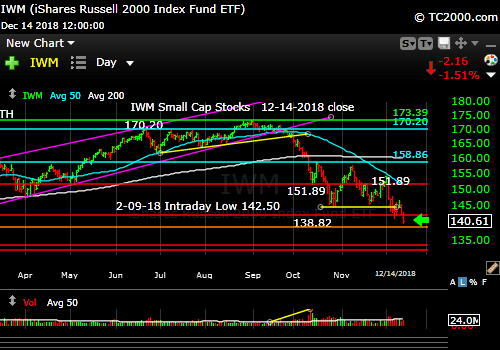
Posted in Bonds, gold, investment, investor sentiment, large cap stocks, S&P 500 Index, small cap stocks, Treasuries | Tagged , , , , , , , , , , , , , , , , , | 2 Comments

Market Timing Brief™ for the 11-16-2018 Close: A Chance for a Stock Market Bounce? How High? Even Gold is Perking Up as Rates Fall.

A Market Timing Report based on the 11-16-2018 Close, published Saturday, November 17th, 2018…

I deliver focused comments on market timing once a week.  These are supplemented with daily “Tweets/StockTwits” (see links below).

1.  SP500 Index Market Timing (S&P 500 Index®; SPY, SPX):

To be sure of the short and the longer term market direction, we need to check in our “Must Not” List again this week.  This will help you to keep oriented to the truly important issues in order to make wise investment decisions…

1. “The interest rate on the U.S. 10 Year Treasury (TNX) must not move over 3.248%.  It especially cannot do that quickly, or we’ll see RateShockIII.”

This is no threat at the moment. Rates have been falling.  The coincidence of massive corporate debt, massive deficits, inflation from tariffs, and inflation from rising wages at the end of the economic cycle could cause the economy to fall into stagflation vs. a deflationary slowdown.

The latter seems to be occurring in part due to an overeager Federal Reserve, which is raising short term interest rates into a global economic slowdown.  Remember, it is not a slowing from positive to negative growth we are talking about; it is a slowing from more positive growth to less positive growth, a deceleration.

2. “Earnings and revenues cannot continue to deteriorate.  The market must be able to see the reversal of this global slowdown coming to reverse the decline confidently.  The test is to see analyst estimates of both E and Rev improving over time.”

Things could get worse.  Slowing can lead to more slowing.  It already has.   China slowing has already fed through to Apple slowing as I predicted it would.

That’s the way slowing feeds through the global economy.  China is slowing so their market goes down.  Then the rich Chinese consumer feels the pinch of their portfolio being cut by 25-30% and does not buy the next Apple iPhone upgrade, because it’s just not something s/he has to have.  Then Apple revenue and earnings go down, and the CFO tells us on the Apple earnings call that they will no longer report unit sales of iPhones.  Then Apple stock falls quickly…. 

I predicted Apple’s stock would fall by seeing that this sequence would play out.  People who own such stocks may become upset when they read my comments, because they are defending their positions, but isn’t it better to know the truth and be able to invest according to what is true rather than to hide from it?  Isn’t it better to at the minimum take profits or reduce or eliminate your position before the news comes out?

How’s it going in the United States?  The FactSet numbers on SP500 Earnings just one week later during the end of this earnings cycle are worse in earnings terms than they were just last week.  Those sorts of downward revisions on top of downward revisions may continue.

3. “The President must not be impeached.”

Getting the answer on this will take a while…a long while.  We know of no evidence of Trump “colluding” or otherwise breaking the law to date, but if Mueller ends up having serious accusations directly involving Trump, there will be trouble.   (I covered the comparison to Clinton’s successful impeachment HERE.)

4. “The China Trade War must not be continued.  It must be ended or the trajectory altered prior to 25% tariffs being imposed in January.”

The market clearly hopes the trade war should find a truce of some sort at the meeting between Trump and Xi during the G20 Summit of Nov.20-Dec. 1.  How the Chinese would get a deal and not be forced to deal with intellectual property theft, state subsidized price competition, and one sided tariffs on American products is frankly incomprehensible. 

I do not believe Trump will let them get away with it, which he must get credit for (despite what else you or I may think of him; I look at each thing he says and does separately.  I look at the sum total only for an election. ). 

The Chinese leadership is known for its stubbornness, not to mention President Xi has absolute power, so this could be a very drawn out process with the clear potential to cause further volatility in the stock market.  It’s not among the core issues, but it effects some of the core issues in a non-trivial way. 

The market has grown tired of “The Tweet that Cried Wolf,” followed by NEC Director Larry Kudlow emerging on the south lawn of the White House to refute any notion of trade war resolution being in sight.  Trump will actually have to come to an agreement with Xi to give the market some real meat to chew on.

5. “Oil must not spike higher than 75ish, a prior high.  Since oil is now in a Bear market, that is not a problem we face currently.”

Oil has crashed despite the most recent bounce to about $57, so this is not currently an issue.

6. A #Fed Focused must not myopically focus on inflation ONLY:  I laid out one of the other central risks for the market last week, which many pundits have been discussing: “The Fed has a Congressional mandate to contain inflation as well as seek maximum employment.  The latter goal has been accomplished in their view, so the whole game is controlling inflation now.  That is the Fed’s ONLY job for now.”  That’s what it thinks at least!

You see, the Fed does not need to stay below the current level of unemployment to meet its mandate.  Five percent is the generally accepted level of “full employment,” so they think they can tighten monetary policy, even if it means some will have to lose their jobs.

Until the Fed sees inflation itself slow, they may not be willing to move to a more dovish position, despite what jobs may be lost.  It’s an odd way to run a country isn’t it?   The Federal Reserve allowed monetary policy to become too loose, and now everyone and their grandma says that they are making it too tight and are hurting the economy. 

Getting back to the deterioration of earnings for U.S. companies…

Earnings projections have deteriorated a bit more since last week as further SP500 reports have come in.  As I explained, the cycle cycles in on itself, so things can worsen before the turn comes without any other intervention.  The latest FactSet PDF  for the Nov. 16 earnings data will open directly HERE (link may only work for a week or so, so download it).

Last week I told you the market was unlikely to bounce straight up from the lower channel line of the 2017 upward channel for the SP500 Index (orange lines on the first chart below).  I was right.

The SP500 Index fell to the prime target I suggested COULD hold, which was the October 11th low.  Matching that low would as I said last week create a reverse head and shoulders formation, which is interpreted as Bullish by chartists who are looking for turning points.

In fact, on social media, I predicted they would start talking about this “reverse head and shoulders” possibility soon, and they did so the very next day on CNBC.  What you read here, you will find will often appear on CNBC a day or two or even weeks to months later.  That’s the purpose of my bothering to write.  I write to discuss with you what is GOING to happen, not tell you just what is happening or what already happened.  The latter two are very important, but not enough to get the bigger turns right. 

So far, that technical level of the Oct. 11th low seems to be working, more or less.  For the tech heavy QQQ, it’s working “less well” as the level is 167.81 and the close Fri. was 167.50.  Close but no cigar!  For small caps, “it’s close,” as the IWM level is 151.89 and the close was barely above there at 151.94.

For midcap IJH it is working as the level is 183.97, and the close was 186.20.  For large cap SPY it is also working as the level is 270.36 and the close was 273.73.  The VIX volatility index cooperated as well and closed at 18.14, below the 18.75 Bull target I set for the Bulls on Friday.  (I share these numbers most days, although some of them carry over, so please record them when you see me tweet them.)  There is more on the VIX numbers at the bottom section of this report, for those who follow them with me…

Now let’s check in on two “Canary Signals” we’ve been following:

“Intel-igent Market Timing Signal” (Intel; INTC):  Negative.  INTC is trying to break up out of the down channel, and has done so a bit, but must now move higher than three landmarks: the earlier Nov. high, the 200 day moving average (mav), and the Oct. high as well.  It has moved above the 50 day mav, which is a start. 

A recovery of Intel while Nvidia is in the midst of a temporary collapse may have less significance to the overall market, but it would still impress me.  (Reminder: INTC was/is our “tell” on 2nd half earnings in tech as noted HERE.  We are now well into the 4th quarter.)

Bank of America (BAC) Market Timing Signal: Negative.  Keep an eye on 27.63 as a reversal number for BAC.  Then breaking UP through the 50 day then 200 day mav’s obviously would be very positive should it happen.  That likely will only happen if interest rates return to rising vs. falling.  They’ve been falling since 11-09. 

So what’s the upside target if this SP500 Index reverse head and shoulders formation works out?  Typically a chartist would flip the rev. H&S formation up to the level of the reflection across the bases of the shoulders to guesstimate a target, which would mean a brand new all time high of 3029 for SP500 or 303ish for SPY, which is a rise of 10.7% from here.

That would imply a resumption of the Bull market, which seems unlikely in macroeconomic terms…

If we assume “It ain’t over,” meaning we are in a continuing “Correction” or a “Mini Bear Market” (my definitions are HERE) what COULD the SP500 Index Bounce Targets be?

  1. 200 day mav is at 2760.69 for SP500 Index: Not likely as a target, as it is too close to where we are (2736.27), just 0.89% higher.
  2. Lower 2017 channel line (orange line) at 2780: also a bit close at 1.60% higher.
  3. The down trend line between the 10-03 high and the 11-08 high at 2791 (not shown but it’s just the down trend line on the daily chart): 2.00% higher.  Possible, though it would be very disappointing to the Bulls.
  4. The 50 day mav at 2812.69 (changes daily).  2.79% higher.
  5. The 10-17 high of 2816.94: 2.95% higher.
  6. The Jan. high of 2863.43: 4.65% higher.
  7. The All Time High (ATH) of 2940.91 on 9-21-18 (intraday): 7.48% higher.

My bet would be on exceeding the 50 day mav at a minimum (2.79%+). Rising above it sucks in more over eager Bulls, who begin to believe “Whew! It’s over now!” and so the rise usually overshoots the 50 day mav.  I’d say the SP500 Index may fail between the 50 day mav and the January high for a gain of 2.79% to 4.65%. 

WARNING: There are things I have wanted for Christmas I’ve never gotten, so this is not a “set it and forget it” process.   😉   (See how I’m starting to decorate the blog in GREEN and RED earlier and earlier in the year?  lol)

Remember these levels are just levels, whether moving averages or head and shoulders or foot and mouth (there is no such thing ;))!   They mean nothing out of context.  What I observe AT the levels matters far more than the levels themselves, which is why keeping in touch via social media is so important, and here is where you do it…

Keep up-to-date during the week at Twitter and StockTwits (links below) where a combined 33,738 investors are following the markets with me…

Follow Me on Twitter®  Follow Me on StockTwits®.

SP500 Large Cap Index (click chart to enlarge; SPX, SPY):

sp500-index-spx-market-timing-chart-2018-11-16-close

Finding support?

Survey Says!  Sentiment of individual investors (AAII.com) showed a Bull minus Bear percentage spread of -0.87% vs. +10.09% the prior week.  The poll closed the evening of the low close for the week.  It’s amazing that sentiment did not deteriorate more than that.  There’s not enough fear for a real bottom, but that does not dictate when that bottom may occur.

AAII.Com Individual Investor Sentiment Poll
Bulls Neutrals Bears
35.09% 28.95% 35.96%
Thurs. 12 am CT close to poll

2.  U.S. Small Caps Market Timing (IWM):  Last week I said: “You can see that 151.89 target is an easy one to reach from here.  IWM should hit that top red line on Monday in my view.”   It did, and then overshot to the downside, but then recovered to just above my target, which is positive for a bounce. 

And now we bounce or we don’t, but I’ve laid out the parameters for the large caps, and you can figure things out for yourself for the small caps.  I am going to avoid them, because we are still in a global slowing period that won’t last just one quarter.  If you play a bounce in them, you still sell them at the tops of the bounces, as close as you can get, in my view.

Russell 2000 U.S. Small Cap Index  (click chart to enlarge; IWM, RUT):

NOTE: THE CHART IS FOR THE 11-16-18 CLOSE DESPITE THE LABEL

iwm-russell-2000-market-timing-chart-2018-11-16-close

Small caps are above target for a bounce from this level.

3. Gold Market Timing (GLD):  Rates are falling and gold is perking back up.  If rates continue falling, gold will continue rallying as the dollar softens a bit as well.  (There is more detail in prior issues.)

The Gold ETF (click chart to enlarge the chart; GLD):

gld-gold-etf-market-timing-chart-2018-11-16-close

Back up above the prior range of trading for another rally attempt.

4. Interest Rate Market Timing – U.S. 10 Year Treasury Note Yield (TNX):

Rates are falling but have a chance to bounce soon from the Oct. low due to “Risk On” positioning in the stock market, if this equity bounce continues.

Check out the “Market Signal Summary” below – after you review the following chart…

U.S. 10 Year Treasury Note Yield (click chart to enlarge; TNX, IEF, TYX, TLT, TBF):

tnx-10-year-treasury-note-market-timing-chart-2018-11-16-close

Rates may bounce on a “Risk On” bounce.

Now let’s review three key market timing signals together…. 

Do not use these signals as a trading plan.  They are rough guidelines.  I currently share my own moves on social media (links above).

MY MARKET SIGNAL AND TREND SUMMARY for a Further U.S. Stock Market Rally with Real GDP Growth (“Real” means above inflation):

Stock Signal RED for a further U.S. stock market rally with a BEARISH SP500 Index trend. (The Signal here is based on the small caps, but I’m sure you can divine their trend is also Bearish!)

Despite the possibility of a bounce here, more healing (economic and technical) must occur before the market can shift back to Bullish.  The VIX (which relates to SPX volatility) closed at 18.14 vs. 17.36 last week, so the Bulls have more work to do!

VIX Bull Targets: The Bulls must first get through (drop below) 17.24 and then retake the 8-15 high of 16.86. The next step would be taking back 16.09 to create a new recent daily low.   The ‘Bull Nirvana Target’ is our VIX # of the Year: 13.31.  As I said several weeks ago, ‘Super Bull Nirvana would be VIX below 11.22, but I have the feeling it will take a while to get back there.’

The Bears only got to 22.97 in this last upswing in volatility.  Two weeks ago: “The Bears need to take out the 26ish top that was tested once again this week for the market to  go into another leg of  decline.  If they do it soon, it COULD still just last a day or two.”  As before, VIX 28.84 is the Bear target for Armageddon (another big chunk of losses driving SPX down to the May lows or worse).

Gold Signal RED for a further U.S. stock market rally with a  BULLISH Gold Trend.   Tentatively Bullish that is, as rates must cooperate by moving still lower below the Oct. TNX low.

From before: “Remember GLD is being used as an indicator for the ECONOMY here.” 

Rate Signal  RED  for a further stock market rally with a BEARISH 10 Year Yield Trend. 

As said: “The up trend is still broken until the lower high is exceeded   All heck would break loose for equities if TNX lurches above 3.248%, particularly if the rise is rapid.  You buy long dated Treasuries as close as you can to 3.248% (IEF, TLT, etc.).”  At this point, I will likely wait for a bounce in rates. 

I’m leaving this important statement here until things change: “This level of the 10 Year Treasury Yield, which is too high for current conditions as explained HERE, will eventually slow the economy.”

Sept. 28th issue: “A rapid push higher in rates would mean trouble for stocks, as occurred in early 2018.”  That’s what I call “Rate Shock.”  This period of rising rates is #RateShockII.”

Thank you for reading.  Would you please leave your comments below where it says “Leave a Reply”… or ask a question or report a typo…  Pay it forward too by sending the link to MarketTiming.Blog (that link will immediately connect them to this webpage) to a relative or friend.  Thanks for doing that.

Be sure to visit the website for more general investing knowledge at:

Sun and Storm Investing™

Standard Disclaimer: It’s your money and your decision as to how to invest it.

I thank Worden Brothers for the charting system I use to post these charts.  If you want to know more about the charting system I use every day, go HEREIt makes it much easier to follow along with me if you can see the charts and manipulate them on your own computer.  It’s a great investment to have an excellent charting system.  Check it out with a free trial at the link above.  I am an affiliate of Worden Brothers, though oddly I’ve never been paid a cent by them.  If you HAVE subscribed to their service, please send me a message. 😉

Finally: Please excuse and REPORT all typos if you are so moved.  I do my best to pick up most of them, but have not always found them all.  Shoot me a typo report HERE.

Note: I’ve updated my criteria for the equity signal for a further U.S. stock market rally to the following: GREEN = Bullish, YELLOW = Neutral, RED = Bearish.  In other words, the colors tell you whether the signal supports the stock rally or not, while the Bullish, Neutral, and Bearish designations are about the trend. 

A BEARISH trend signal does not mean we should not buy.  A BULLISH trend signal does not mean you cannot sell some exposure.  It depends on what is going on in the economy and how oversold/overbought the market is at a given point whether the Bearish signal is to be sold, sold on the next bounce, etc. and whether a Bullish signal is to be bought or if profits should be taken.  A NEUTRAL trend signal does not mean the end of the Bull or Bear. It means to wait and look for possible subsequent entry points within the existing trend, Bull or Bear, but preserve capital if the entry fails.  Our strong intention is to buy low and sell high.  By the way, I will keep showing the prior orange “Trigger lines” in the charts for now as reference points only; they have historical value for us from the post-2016 election period.

Copyright © 2018 By Wall Street Sun and Storm Report, LLC All rights reserved.
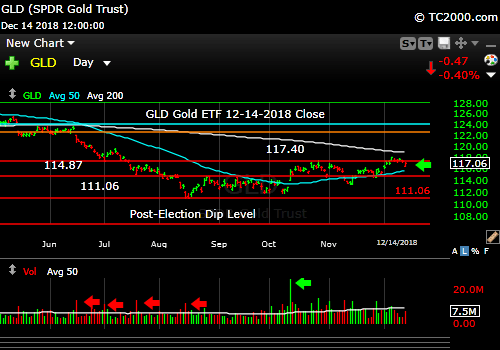
Posted in Bonds, gold, investment, investor sentiment, large cap stocks, S&P 500 Index, small cap stocks, Treasuries | Tagged , , , , , , , , , , , , , , , , , , , | 4 Comments

Market Timing Brief™ for the 11-09-2018 Close: Stocks Falling from a Lower High. Five “Must Nots.” Gold Slips. Rates Re-Top and Fall.

A Market Timing Report based on the 11-09-2018 Close, published Saturday, November 10th, 2018…

I deliver focused comments on market timing once a week.  These are supplemented with daily “Tweets/StockTwits” (see links below).

1.  SP500 Index Market Timing (S&P 500 Index®; SPY, SPX):

I called for a bounce, but at the end of this week, I called for a trounce, which began subtly on Thursday when I sold a chuck of stock exposure.  On Friday, the market started to fall again in earnest.  I’ll get to “how low will it go” after sharing some insights.

The market does not always immediately do what I say it will do as my long time readers know.  This time, I was right on time.  Sometimes I am early.  Sometimes I’m late.  The market loves to make fools of us all, so I assume each call I make is tentative/to be proven, and so should you.  Decide for yourself what actions you will take if any.  IF the thesis is right that the market will continue to correct further, but not drop more than 25% (which is the upper limit of my “Mini Bear Market” definition), and then recover, do you really have to sell?  Not really. But you may preserve more capital if you sell the tops and buy the lows, even if you are off a day or two.

But how can we be completely sure an earnings slowdown with growth slowing globally will not turn into a recession?  For a recovery from this correction and avoidance of what I term a “Big Bear Market” (terms defined HERE), these things must NOT happen…

1. The interest rate on the U.S. 10 Year Treasury (TNX) must not move over 3.248%.  It especially cannot do that quickly, or we’ll see RateShockIII.  Read past posts on the #RateShock principle to catch up (top section of 10-05-18 post).  The big mistake many make is using prior U.S. rate history to make their arguments without considering the global rate context!  That’s just plain dumb.

2. Earnings and revenues cannot continue to deteriorate.  The market must be able to see the reversal of this global slowdown coming to reverse the decline confidently.  The test is to see analyst estimates of both E and Rev improving over time.

3. The President must not be impeached.  That alone won’t create a “Big Bear Market” per my terminology, but could take us to a maximum “Mini Bear” as I call a decline that can go as high as 25%.  Since the GOP controls the Senate, conviction will only happen if the President has done something egregious such as directly collude with the Russian government in a direct way to undermine Clinton in the 2016 election, something we have no hard evidence for to date.  Not reporting a payoff to a porn star could be overlooked by the Senate, like it or not.  Clinton paid off Paula Jones to keep her quiet about the sex she had with him. Was that a failure to report a campaign contribution, because it made him more electable? That’s not what the Senate decided.  They acquitted him after his House impeachment.

Most of the charges by Mueller relate to tax issues and lying to the FBI etc.  on the part of Trump associates.

The catch would be obstruction of justice.  Nixon was kicked out on the basis of obstruction of justice, NOT his participation in the Watergate break-in.  However, there would have to be hard evidence against Trump for the Senate to give him the boot.

I’ve written before on the impact of the Clinton impeachment HERE.  The drawdown would likely be similar if Trump is impeached, but not convicted.

4. The China Trade War must not be continued.  It must be ended or the trajectory altered prior to 25% tariffs being imposed in January.  Companies are already complaining about cost increases due to the tariffs, and this does not help the Fed keep interest rates low.  Trump has chastised the Fed for raising rates, while he contributes to inflation by: 1. Tax cuts that are inflationary and raise the cost of debt by raising the national debt level and 2. Imposition of tariffs that impact company manufacturing input costs, some of which are passed on to consumers.

The Fed has a Congressional mandate to contain inflation as well as seek maximum employment.  The latter goal has been accomplished in their view, so the whole game is controlling inflation now.  That is the Fed’s ONLY job for now.  And Trump is making that job much harder. 

Trump is slated to meet with China’s Xi at the Nov. 30-Dec. 1 2018 G20 meeting in ArgentinaIf a deal is made then, it could goose the market once again. Trump was able to directly manipulate the market upward with his comments just before the election, although Larry Kudlow, the Director of the National Economic Council, tamped down expectations shortly after Trump tweeted.

5. Oil must not spike higher than 75ish, a prior high.  Since oil is now in a Bear market, that is not a problem we face currently.  Trump is allowing Iran to “cheat” by selling to certain countries. What the point of a “non-embargo embargo” is, is not clear.  Oil below a certain price carries with it some financial danger, as oil companies go belly up when they can no longer service their debts.  The oil price needs to be “just right.”  I would say below $40/barrel, the caution lights start flashing.  Oil has been in a decline since the high of October 3rd.  The SP500 re-topped (just below the all time high) on October 3rd as well. Coincidence?  Remember that growth slowing means less oil demand, so my answer is “I highly doubt it!”

Getting back to the deterioration of earnings for U.S. companies…

Below is an update of last week’s analysis comparing the FactSet published analyst projections into Q2 2019 made back in my 7-22-2018 issue which referenced their 7-20-2018 data to the current projections as of Nov. 9th.  This week, I compare them to last week’s data. 

Guess what?  Earnings projections are even LOWER than before from the current Q4 quarter all the way out to Q2 2019 which will be reported starting in July 2019.  They could continue to get worse, if global slowing continues to percolate through the U.S. economy.

Here is the data (latest FactSet PDF  for the Nov. 9 data below will open directly HERE):

7-20-18: Prior Quarter (Q3): For Q3 2018, analysts are projecting earnings growth of 21.6% and revenue growth of 7.5%.
Actual: companies are reporting earnings growth of 25.2% (vs. 24.9% last week) and revenue growth of 9.4% (8.5% last week).
Relative performance: Earnings Growth = 16.7% HIGHER (ALL vs. July predictions).  Rev. Growth = 25.3% higher.

7-20-18: For Q4 2018, analysts are projecting earnings growth of 18.0% and revenue growth of 5.7%.
Now: For Q4 2018, analysts are projecting earnings growth of 15.0% and revenue growth of 6.8%.  11/09/18:  E 14.2%/Rev 6.7%.
Relative performance: Earnings Growth = was 16.7% LOWER, now 21.1% LOWER.  Rev. Growth = was 19.3% higher, now 17.5% higher.

7-20-18: For Q1 2019, analysts are projecting earnings growth of 7.1% and revenue growth of 5.5%.
Now: For Q1 2019, analysts are projecting earnings growth of 6.0% and revenue growth of 6.6%.  11/09/17:  E 5.6%/Rev. 6.6%
Relative performance: Earnings Growth = was 15.5% LOWER, now 21.1% lower.  Rev. Growth = was 20.0% higher, now still 20% lower.

7-20-18: For Q2 2019, analysts are projecting earnings growth of 10.4% and revenue growth of 4.7%.
Now: For Q2 2019, analysts are projecting earnings growth of 6.5% and revenue growth of 5.1%.  11/09.18: E 6.2%/Rev 5.3%.
Relative performance: Earnings Growth = was 37.5% LOWER, now 40.4% lower. Rev. Growth = was 8.5% higher, now 12.8% higher.

As I said last week: “…earnings growth expectations between that 7-20-18 report and the 11-02-18 report have fallen considerably, which means stock prices have to adjust.”  How much stock prices adjust will depend on the factors noted in my above list of 5 trouble spots. 

Last Saturday I wrote: “We are not out of the woods yet.”

I told you two weeks ago: “I am OK with my exposure level being between 75 and 85% roughly as I trade in and out of the bounces and trounces to come.  This is not going to be a straight line.  Manage your exposure level to a point you are comfortable with…”  My current exposure level is noted on social media. 

The exposures I bought last week were working this week.  A REIT I bought as a “Happy Floater” (floating above the falling market) was still going up on Friday with the market down almost 1%.  My utility position is up 3.5% since the buy on 11-02-18.

Realize however that if a market drawdown accelerates, it can easily bring EVERY sector down.  The relative performance may be better in utilities and REITS at certain times, but the absolute return can still be negative.

Selling exposure and raising cash at the market’s lower highs or shorting the market (which most investors won’t ever do) are the only ways to protect/increase capital on an absolute basis during drawdowns like this.

Now let’s check in on two “Canary Signals” we’ve been following:

“Intel-igent Market Timing Signal” (Intel; INTC):  Negative.  The stock is now retracing to test the upper line of the down channel it is in.  It is below the October high and more selling on Monday would like define the last bounce up as a failed rally in a downtrend.  It would be significant if Intel could break up and out above the Oct. high instead! (Reminder: INTC is our “tell” on 2nd half earnings in tech as noted HERE.)

Bank of America (BAC) Market Timing Signal: Negative.  I said it would likely fail from the 50 day moving average (mav), and it did not quite get there before turning down.  Breaking UP through the 50 day then 200 day mav’s would be very positive should it happen.

The 2017 channel line is in orange on the chart below…speaking of which, the SP500 Index stopped almost exactly on that line as well as testing barely above the 200 day mav.  These levels are not sacred, but they are watched.  They only have significance when we observe the market’s behavior as they are tested to PROVE their significance, which is why my ability to communicate with you virtually real time on social media is so important.  My first prime target to examine will be that lower yellow line in the chart below.  Ultimately, could the market fall to retest the May low again or even go to the April or Feb. low?  Of course, but the first opportunity for a reversal in my opinion comes at that yellow line.  

Could the market simply bounce UP from here?  Yes, but it would take a tangible important catalyst to do that such as a real resolution of the trade war with China. With the elections over as predicted (plus or minus), there is no election catalyst to be had.  Infrastructure could become a catalyst especially for certain stocks, but it won’t come this year.  Without a catalyst, the market will most likely move to a lower retest as outlined above.

Keep up-to-date during the week at Twitter and StockTwits (links below) where a combined 33,722 investors are following the markets with me…

Follow Me on Twitter®  Follow Me on StockTwits®.

SP500 Large Cap Index (click chart to enlarge; SPX, SPY):

sp500-index-spx-market-timing-chart-2018-11-09-close

Failed at a bounce to a lower high.

Survey Says!  Sentiment of individual investors (AAII.com) showed a Bull minus Bear percentage spread of 10.09% vs. +3.45% last week.  The poll closed on the day of the double top in the SP500 Index.  Sentiment is not particularly helpful other than to say that at the lower top, investors were not all that Bullish.  There is plenty of room for downside in sentiment.

AAII.Com Individual Investor Sentiment Poll
Bulls Neutrals Bears
41.28% 27.52% 31.19%
Thurs. 12 am CT close to poll

2.  U.S. Small Caps Market Timing (IWM):  They led on the way up, but they are also leading on the way down.  Liquidity is an issue for small caps, so when there are too many sellers, small caps stocks go down 10-20% in a day.  Facebook fell 19% in a day based on a big, bad surprise for the market, so this liquidity issue is not entirely restricted to small caps, although it’s generally more of an issue.  You can see that 151.89 target is an easy one to reach from here.  IWM should hit that top red line on Monday in my view.

Russell 2000 U.S. Small Cap Index  (click chart to enlarge; IWM, RUT):

iwm-russell-2000-market-timing-chart-2018-11-09-close

Small caps sold off hard on Friday.

3. Gold Market Timing (GLD):  GLD slipped on the Friday PPI data, which was warm in inflation terms.  Yet gold fell as rates fell, despite that data, which is not a good response.  GLD ended at 0.01 below the 50 day mav and back below 114.87, which was the top of the prior range preceding the now failed breakout.  None of that is constructive, although falling rates should eventually support gold.

The Gold ETF (click chart to enlarge the chart; GLD):

gld-gold-etf-market-timing-chart-2018-11-09-close

Gold slipping. Falling rates will help.

4. Interest Rate Market Timing – U.S. 10 Year Treasury Note Yield (TNX):

The interpretation of interest rates is muddied a bit by the fall in the stock market this Friday.  Risk off means Treasuries are bought with cash raised by selling stocks.  Taken by itself, it looks like rates have peaked, but this must now be confirmed by November reports of LOWER inflationary pressures.  It must also be confirmed by a further fall in the 10 Year Yield shown in the chart below.   That hurt’s financials like BAC, by the way.  See my advice on how to play this fall in rates below the chart…

Check out the “Market Signal Summary” below – after you review the following chart…

U.S. 10 Year Treasury Note Yield (click chart to enlarge; TNX, IEF, TYX, TLT, TBF):

tnx-10-year-treasury-note-market-timing-chart-2018-11-09-close

Retested top? Or will there be more inflation scares?

Now let’s review three key market timing signals together…. 

Do not use these signals as a trading plan.  They are rough guidelines.  I currently share my own moves on social media (links above).

MY MARKET SIGNAL AND TREND SUMMARY for a Further U.S. Stock Market Rally with Real GDP Growth (“Real” means above inflation):

Stock Signal RED for a further U.S. stock market rally with a BEARISH SP500 Index trend.

The trend is Bearish particularly because the SP500 Index is falling off a lower double top.  The VIX (which relates to SPX volatility) closed at 17.36 above the low of 17.06 set at the 10-17 intraday market top.  It was below last Friday’s 19.51 close.

The Bulls must retake the 8-15 high of 16.86 (break down below it). The ‘Bull Nirvana Target’ is our VIX # of the Year: 13.31.  As I said 2 wks ago, ‘Super Bull Nirvana would be VIX below 11.22, but I have the feeling it will take a while to get back there.'” VIX 17.06 is the immediate Bull target. Then the nearby 16.86 etc.

Last week: “The Bears need to take out the 26ish top that was tested once again this week for the market to  go into another leg of  decline.  If they do it soon, it COULD still just last a day or two.”  It lasted a day and then the market bounced.  VIX 28.84 is the Bear target for Armageddon (another big chunk of losses driving SPX down to the May lows or worse).

Gold Signal  NEUTRAL  for a further U.S. stock market rally with a  NEUTRAL Gold Trend.

From before: “Remember GLD is being used as an indicator for the ECONOMY here.  The trend is neutral due to the loss of a breakout.

Rate Signal  RED  for a further stock market rally with a BEARISH 10 Year Yield Trend.  The up trend is still broken until the lower high is exceeded (see above).  All heck would break loose for equities if TNX lurches above 3.248%, particularly if the rise is rapid.

For now, this is where you buy long dated Treasuries as close as you can to 3.248% (IEF, TLT, etc.)

I’m leaving this important statement here until things change: “This level of the 10 Year Treasury Yield, which is too high for current conditions as explained HERE, will eventually slow the economy.”

Sept. 28th issue: “A rapid push higher in rates would mean trouble for stocks, as occurred in early 2018.”  That’s what I call “Rate Shock.”  This period of rising rates is #RateShockII.”

Note: I’ve updated my criteria for the equity signal for a further U.S. stock market rally to the following: GREEN = Bullish, YELLOW = Neutral, RED = Bearish.  In other words, the colors tell you whether the signal supports the stock rally or not, while the Bullish, Neutral, and Bearish designations are about the trend. 

A BEARISH trend signal does not mean we should not buy.  A BULLISH trend signal does not mean you cannot sell some exposure.  It depends on what is going on in the economy and how oversold/overbought the market is at a given point whether the Bearish signal is to be sold, sold on the next bounce, etc. and whether a Bullish signal is to be bought or if profits should be taken.  A NEUTRAL trend signal does not mean the end of the Bull or Bear. It means to wait and look for possible subsequent entry points within the existing trend, Bull or Bear, but preserve capital if the entry fails.  Our strong intention is to buy low and sell high.  By the way, I will keep showing the prior orange “Trigger lines” in the charts for now as reference points only; they have historical value for us from the post-2016 election period.

Thank you for reading.  Would you please leave your comments below where it says “Leave a Reply”… or ask a question…  Pay it forward too by sending the link to MarketTiming.Blog (that link will immediately connect them to this webpage) to a relative or friend.  Thanks for doing that.

Be sure to visit the website for more general investing knowledge at:

Sun and Storm Investing™

Standard Disclaimer: It’s your money and your decision as to how to invest it.

I thank Worden Brothers for the charting system I use to post these charts.  If you want to know more about the charting system I use every day, go to my “Other Resources” page here:  Other Resources   It makes it much easier to follow along with me if you can see the charts and manipulate them on your own computer.  It’s a great investment to have an excellent charting system.  Check it out with a free trial at the link above.

Finally: Please excuse and report all typos if you are so moved.  I do my best to pick up most of them, but have not always found them all.  Shoot me a comment (I don’t have to post your typo report as I filter them before publication, but I’ll be grateful to you!)

Copyright © 2018 By Wall Street Sun and Storm Report, LLC All rights reserved.

Posted in Bonds, gold, investment, investor sentiment, large cap stocks, S&P 500 Index, small cap stocks, Treasuries | Tagged , , , , , , , , , , , , , , , , , , | Leave a comment

Market Timing Brief™ for the 11-02-2018 Close: Are Stocks Out of the Woods? Post-Election Tremors Expected? Small Caps Lead the Bounce. Gold Pausing on Rate Bounce to a Lower High.

A Market Timing Report based on the 11-02-2018 Close, published Saturday, November 3rd, 2018…

I deliver focused comments on market timing once a week.  These are supplemented with daily “Tweets/StockTwits” (see links below).

1.  SP500 Index Market Timing (S&P 500 Index®; SPY, SPX):

Last week I asked, “Will the May Low Hold?”

It did, and a bounce began from it.  Realize that tests sometimes go a bit farther than the original lows that are tested.  A breach intraday does not mean the same thing as a closing breach, which is why many traders use only closes to determine whether they will sell.  Before getting deeper into the charts, let’s review the major current market challenges and their importance:

1. The 2018 Midterm Elections: The Democrats are currently expected to win the House back and the Republicans are expected to make some gains in the Senate or at least hold on to a majority.  This scenarios should be OK with the market, although given committee control, the Dems would initiate further investigations into Trump’s election activities, his tax returns, and Kavanaugh.

They may even impeach him in the House, but I think that is hardly a given as these things come back to haunt when reasonable standards are overstepped.  Impeachment would make a Mini Bear more likely as defined last week.  The Senate, under GOP control will of course not convict him unless he has done something they cannot overlook.  I think the Mueller investigation will dead end before it reaches Trump – if he was in fact smart and kept “out of it,” also not a guarantee, given his ego issues.

The best scenario for the market, but not necessarily for people on Medicare and Social Security, and for those with pre-existing health conditions, would be an all GOP win scenario. 

A double Dem win in both Houses of Congress, would be a threat to the market and could lead to much more turmoil and uncertainty for the markets.    Such a win is not predicted at this time by Real Clear Politics. So for now, and we’ll have our answer Tuesday, the election should leave the country with a standoff between Trump and the House. 

In the currently favored scenario, Trump will get nothing that he does not negotiate with the Dems in the House.  The markets won’t react positively or negatively based on that in my view, UNLESS the Democrats impeach Trump (impeachment is done by the House; trial by Senate).  The downside of that would be 20-25%, if it compares to the Clinton December 19, 1988 impeachment. 

2. China Trade War:  This is the biggest ongoing trade war obviously.  President Trump likely lied about the degree of progress that had been made with China on trade in order to goose the stock market directly, and make voters feel better.   I say this because Larry Kudlow denied any real progress had been made just hours before Trump contradicted him.  Larry is a pretty straight shooter.  I’ve watched him since he was on Louis Rukeyser’s Wall Street Week, so I know what he’s about.

I believe the market is seriously worried about continued cost pressures on the U.S. economy secondary to the China Trade War and wants it resolved ASAP.  It is an overhang, but it cannot be seen as an unsolvable impediment to market progress.  Rather, it will cause some volatility, both UP as on Friday as well as DOWN as on Friday!   But the trade war is NOT the top issue.

3. Earnings Growth Slowing: As I said last week: “The central reason the market is heading lower is because of the weak earnings and revenues expected for the SP500 Index companies in Q4 2018 to some extent, then accelerating into Q1 and Q2 of 2019.”  This is still my answer and it has gotten worse!  Here is why….

I just compared the FactSet published analyst projections into Q2 2019 made back in my 7-22-2018 issue which referenced their 7-20-2018 data to the current projections as of Nov. 2nd.  Guess what?  They are now WORSE than before.  And they are likely to become even worse, unless there are upside surprises because global economic growth is slowing.

Here is the data (latest FactSet PDF  for the Nov. 2 data below will open directly HERE):

7-20-18: For Q3 2018, analysts are projecting earnings growth of 21.6% and revenue growth of 7.5%.
Actual: companies are reporting earnings growth of 24.9% and revenue growth of 8.5%.
Relative performance: Earnings Growth = 15.3% HIGHER.  Rev. Growth = 13.3% higher.

7-20-18: For Q4 2018, analysts are projecting earnings growth of 18.0% and revenue growth of 5.7%.
Now: For Q4 2018, analysts are projecting earnings growth of 15.0% and revenue growth of 6.8%.
Relative performance: Earnings Growth = 16.7% LOWER.  Rev. Growth = 19.3% higher.

7-20-18: For Q1 2019, analysts are projecting earnings growth of 7.1% and revenue growth of 5.5%.
Now: For Q1 2019, analysts are projecting earnings growth of 6.0% and revenue growth of 6.6%.
Relative performance: Earnings Growth = 15.5% LOWER. Rev. Growth = 20.0% higher.

7-20-18: For Q2 2019, analysts are projecting earnings growth of 10.4% and revenue growth of 4.7%.
Now: For Q2 2019, analysts are projecting earnings growth of 6.5% and revenue growth of 5.1%.
Relative performance: Earnings Growth = 37.5% LOWER. Rev. Growth = 8.5% higher.

As you can see, earnings growth expectations between that 7-20-18 report and the 11-02-18 report have fallen considerably, which means stock prices have to adjust.

Some of that adjustment is accounted for in the fall to date of 7.41% from the all time high for the SP500 Index.  But how much?  No one can tell you, but realize that if the expectations have declined, they may continue to decline, because you’ll note that revenue expectations are HIGHER now than they were in July.

Why are revenue growth rates higher while there is global slowing?  Is higher pricing on goods expected or more unit sales?  The former creates inflation.

Can companies grow unit sales when global economic growth is slowing?  I believe the SP500 Index revenue numbers will have to be lowered, and then earnings estimates will also be lowered, further lowering the earnings growth rate of the SP500 Index.  Lower E’s, mean PE’s are higher than they should be, and stock prices fall.  

What about oil?  Oil is now in a downtrend and is only a problem for energy stocks.   I pointed that out last week and oil broke to a brand new low, with gas prices falling just before the election!  Well done! 

There is one more lurking threat to the market:  Last week I said: “The 4th reason for a bad break [in the market]: ‘A rate spike of the 10 Year Treasury Yield above 3.248% (without the oil spike) for ANY REASON would induce a further leg down in the SP500 Index and in mid caps and small caps as well of course.’

This week’s reports showed wage inflation was a bit hotter than expected at 3.1% vs. the 3.0% expected and employment was warm too at 250K vs. the 190K expected, but the latter numbers are very volatile from month to month.  The 10 Year Yield finished the week higher however at 3.214% close to the lower high of 3.215%.   I still believe a spike above 3.248% would be taken badly by the stock market.

By the way, I bought some 7 month Treasuries on Friday after the spike, exactly because I believe the 3.25%ish rate top will hold.  They were paying 2.52% annualized yield to maturity.  Not great, but better than a savings account for cash holdings (close to cash at least).  They can be readily sold if I want to deploy more cash into stocks.

Last week I said: “If Apple fails to please investors, ‘Master Market’ [the five year old boy the market truly is] will likely throw a big fit, especially the NASDAQ and QQQs.  I also said, “Apple is a stock that has not come off its top by much.  They had better hit their numbers when they report on Nov. 1st.  The market is saying they WILL hit their numbers.  The mess in China (a big part of their growth is in China), India and elsewhere says they actually may miss their numbers.” 

Apple in fact reported weaker numbers than expected in unit sales terms especially in the emerging markets and fell 6.63% on Friday.  When Luca (CFO) said they no longer would report unit sale numbers, I immediately messaged that this would be taken badly.  They say they are focused on their “ecosystem,” which is a nice way of saying, “We are going to squeeze revenue out of our existing customers, but not increase our device sales numbers by much.”  Apple did not wreck the market, but the QQQ’s were down 1.56% while SPY was down a much more sedate 0.59% after the Trump tweet bounce on the China situation.

I shared how I have adjusted my equity exposure over this period of turmoil in last week’s issue.  Please read it if you have not, because at the least, it will make you think about your risk management process. 

Here’s My Bottom Line and you should reflect on whether it is going to be YOUR bottom line as well, or if you believe something different: (I hope you have data to back up your view, even if it starts with an intuition.)

We are not out of the woods yet. Given the growth slowing backdrop, I am not going to stay fully invested with the exposure I have in a full fledged up trending Bull market, which I call “100% of my max. exposure for a Bull market.” 

I told you last week: “I am OK with my exposure level being between 75 and 85% roughly as I trade in and out of the bounces and trounces to come.  This is not going to be a straight line.  Manage your exposure level to a point you are comfortable with…”

So this week I moved UP my exposure as noted HERE based on the success of the current bounce to a higher level.   I raised it because the election jitters will pass IF the GOP keeps the Senate, which looks probable.  I also believe the China thing will pass, but Trump could make things much worse if he drags his feet.  The “earnings thing” could limit gains to a bounce followed by a trounce.  Bounces can be big however…

How high will the bounce go?  As I’ve said before, I examine the market as it moves higher or lower.  Levels and mav’s (moving averages) don’t mean anything except as rough guides.  It’s how the market looks at these levels that matters to me.  I bought more exposure on Friday, because:

  1. I am adding to SPY (Friday and two buys on 10-22) because that yellow line (chart below) held on a retracement test (and the market was behaving well).  So far, so good. That sets up the market for a possible bounce to the 50 day moving average or so.
  2.  I bought a REIT Friday (starter position, revealed in my room HERE).  Do your own homework on the fundamentals.  I do not claim to be a stock analyst.  I focus mainly on market analysis looking at both technicals and fundamentals.  I look for themes and then look for corroboration from various sources before buying individual stocks.  I also listen to one or more earnings report calls and review the company fundamentals.  In this case my main focus is on the behavior of the stock as a “Happy Floater” (beating the market nicely of late) IN THE CONTEXT OF rates falling from this level.  I may ditch it summarily if it does not perform per my view of it now.  It MUST beat the market in other words, or it’s OUT.  If the 10 yr. yield move to 3.5%, I’ll be out of it most likely.
  3. I bought utilities XLU Friday, near the Friday low, as I believe rates are close to a peak, and utilities rally when yields fall.
  4. Earlier I added to both SPY and Disney, which is a “Happy Floater” too.

For those who missed my “New Rules” last week they are :

New Rules:  Market Drawdown Levels of Note

“Dip” >3%-5%.  “Correction” >5% to 15%.  “Mini Bear” >15% to 25%.  “Big Bears” are >25% (often rising to 50% or more for some markets). 

Now let’s check in on two “Canary Signals” we’ve been following:

“Intel-igent Market Timing Signal” (Intel; INTC):  Negative.  Still a down trend.  Look for a higher high to change that.  Bounces in Bear markets (Bear for this stock) occur commonly back to key levels and then the stocks move down again.  Short the rips, and cover on the dips.  Or play the bounces long if you have the will to do it.  (Reminder: INTC is our “tell” on 2nd half earnings in tech as noted HERE.)

Bank of America (BAC) Market Timing Signal: Negative.  All you have is a tentative reversal above the July low.  That’s a start, but as I believe rates are near a top, I also believe BAC will fall again, even if from the 50 or 200 day mav.

The 2017 channel line is in orange on the chart below…

Keep up-to-date during the week at Twitter and StockTwits (links below) where a combined 33,722 investors are following the markets with me…

Follow Me on Twitter®  Follow Me on StockTwits®.

SP500 Large Cap Index (click chart to enlarge; SPX, SPY): Broke above the down trend line in magenta…

sp500-index-spx-market-timing-chart-2018-11-02-close

Bounce but to where?

Survey Says!  Sentiment of individual investors (AAII.com) showed a Bull minus Bear percentage spread of +3.45% vs. -13.03%.  This does not help much because the poll closed AFTER the bounce off the May low, so they were somewhat reassured.  The prior low achieved was not low enough to call it a washout.

AAII.Com Individual Investor Sentiment Poll
Bulls Neutrals Bears
37.93% 27.59% 34.48%
Thurs. 12 am CT close to poll

2.  U.S. Small Caps Market Timing (IWM):  Last week I said: “The February low (-3.38% away) is an easy target from here, but they’ll probably bounce when the large caps do if not lead the large caps up.”  They fell to the higher of the two lowest days in February and bounced.  And they led the SP500 Index, which is positive.  They were up for the 4th day on Friday, while SPX was lower.  The risk?  They are the most volatile stocks and will do the worst if growth slows further than expected.

Russell 2000 U.S. Small Cap Index  (click chart to enlarge; IWM, RUT):

iwm-russell-2000-market-timing-chart-2018-11-02-close

Tested one of two lowest days in Feb. and bounced.

3. Gold Market Timing (GLD):  GLD pulled back and tested the prior breakout and passed the test.  I had sold it just off the top, because I was anticipating a more negative reaction to the Friday data, which has not come yet. 

If rates press up to 3.25%ish, gold will fall.  Falling rates, which are on their way, will help gold.  I think the market if front running that fall in rates and hence a fall in real rates.  The problem is if Ex-US does worse than we do and there are more crises that pop up, the dollar will rally, which hurts gold UNLESS there is financial panic as I’ve said repeatedly.  Google “When does gold shine and when does it decline?”  Read that post please.  Many of you have!

The Gold ETF (click chart to enlarge the chart; GLD):

gld-gold-etf-market-timing-chart-2018-11-02-close

Gold passed a test this week, and the market may be front running the fall in rates I expect.

4. Interest Rate Market Timing – U.S. 10 Year Treasury Note Yield (TNX):

You can see why I did NOT buy more Treasuries as TNX went down through 3.115%.  It was on the basis of “Risk Off,” not rates falling under their own power to to speak.  Rates are re-peaking now (that’s the hypotheis!).  And rates must fall soon, or the rising rates will hurt stocks badly.  The rest of the world DOES matter more than the Federal Reserve yet understands. Rates in the U.S. effect the entire globe, and have to be taken in the context of global rates, which are mostly very low to negative in most Ex-US developed countries.

Check out the “Market Signal Summary” below – after you review the following chart…

U.S. 10 Year Treasury Note Yield (click chart to enlarge; TNX, IEF, TYX, TLT, TBF):

tnx-10-year-treasury-note-market-timing-chart-2018-11-02-close

Trouble for stocks lies above 3.248%.

Now let’s review three key market timing signals together…. 

Do not use these signals as a trading plan.  They are rough guidelines.  I currently share my own moves on social media (links above).

MY MARKET SIGNAL AND TREND SUMMARY for a Further U.S. Stock Market Rally with Real GDP Growth (“Real” means above inflation):

Stock Signal RED for a further U.S. stock market rally with a BEARISH SP500 Index trend.

The VIX (which relates to SPX volatility) closed at 19.51 Friday vs. 24.16 the previous week.

 I said two weeks ago: “Above 19.55, the VIX level is BEARISH for the SP500 Index, but rising to the 26ish level and then falling could be Bullish short term.  The Bulls must retake the 8-15 high of 16.86 (break down below it). The ‘Bull Nirvana Target’ is our VIX # of the Year: 13.31.  As I said 2 wks ago, ‘Super Bull Nirvana would be VIX below 11.22, but I have the feeling it will take a while to get back there.'” VIX 17.06 is the immediate Bull target. Then the nearby 16.86 etc.

Last week: “The Bears need to take out the 26ish top that was tested once again this week for the market to  go into another leg of  decline.  If they do it soon, it COULD still just last a day or two.”  It lasted a day and then the market bounced.  VIX 28.84 is the Bear target for Armageddon (another big chunk of losses driving SPX down another 6.99% from the Friday close.

Gold Signal  RED for a further U.S. stock market rally with a BULLISH Gold Trend.

From before: “Remember GLD is being used as an indicator for the ECONOMY here.  I am calling it a BULLISH trend, because of both 1) the breakout above the prior trading range and 2) the stability in the face of rising dollar.  GLD needs to break above 117.40 soon.”  Still applies. 

Rate Signal  RED  for a further stock market rally with a BEARISH 10 Year Yield Trend.  The up trend is still broken until the lower high is exceeded (see above).  Then all heck breaks loose for equities if TNX lurches above 3.248%, particularly if the rise is rapid. 

I’m leaving this important statement here until things change: “This level of the 10 Year Treasury Yield, which is too high for current conditions as explained HERE, will eventually slow the economy.”

 Sept. 28th issue: “A rapid push higher in rates would mean trouble for stocks, as occurred in early 2018.”  That’s what I call “Rate Shock.”  This period of rising rates is #RateShockII.”

Note: I’ve updated my criteria for the equity signal for a further U.S. stock market rally to the following: GREEN = Bullish, YELLOW = Neutral, RED = Bearish.  In other words, the colors tell you whether the signal supports the stock rally or not, while the Bullish, Neutral, and Bearish designations are about the trend. 

A BEARISH trend signal does not mean we should not buy.  A BULLISH trend signal does not mean you cannot sell some exposure.  It depends on what is going on in the economy and how oversold/overbought the market is at a given point whether the Bearish signal is to be sold, sold on the next bounce, etc. and whether a Bullish signal is to be bought or if profits should be taken.  A NEUTRAL trend signal does not mean the end of the Bull or Bear. It means to wait and look for possible subsequent entry points within the existing trend, Bull or Bear, but preserve capital if the entry fails.  Our strong intention is to buy low and sell high.  By the way, I will keep showing the prior orange “Trigger lines” in the charts for now as reference points only; they have historical value for us from the post-2016 election period.

Thank you for reading.  Would you please leave your comments below where it says “Leave a Reply”… or ask a question…  Pay it forward too by sending the link to MarketTiming.Blog (that link will immediately connect them to this webpage) to a relative or friend.  Thanks for doing that.

Be sure to visit the website for more general investing knowledge at:

Sun and Storm Investing™

Standard Disclaimer: It’s your money and your decision as to how to invest it.

I thank Worden Brothers for the charting system I use to post these charts.  If you want to know more about the charting system I use every day, go to my “Other Resources” page here:  Other Resources   It makes it much easier to follow along with me if you can see the charts and manipulate them on your own computer.  It’s a great investment to have an excellent charting system.  Check it out with a free trial at the link above.

Finally: Please excuse and report all typos if you are so moved.  I do my best to pick up most of them, but have not always found them all.  Shoot me a comment (I don’t have to post your typo report as I filter them before publication, but I’ll be grateful to you!)

Copyright © 2018 By Wall Street Sun and Storm Report, LLC All rights reserved.
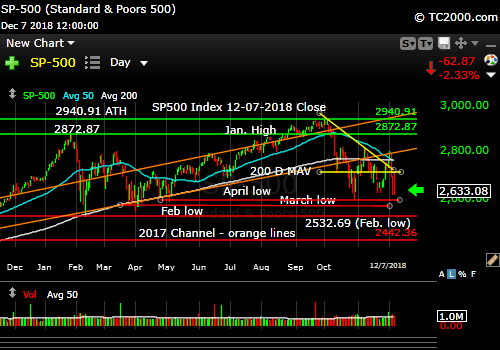
Posted in Bonds, gold, investment, investor sentiment, large cap stocks, S&P 500 Index, small cap stocks, Treasuries | Tagged , , , , , , , , , , , , , , , , , , , , | Leave a comment

Market Timing Brief™ for the 10-26-2018 Close: My “New Rules for Bull and Bear Markets.” Will the May Low Hold for the S&P 500 Index? Gold Treading Water but Up. Rates Falling Again.

A Market Timing Report based on the 10-26-2018 Close, published Saturday, October 27th, 2018…

I deliver focused comments on market timing once or twice a week.  These are supplemented with daily “Tweets/StockTwits” (see links below).

1.  SP500 Index Market Timing (S&P 500 Index®; SPY, SPX):

Last week I asked, “WILL THE 2017 CHANNEL and 200 DAY MAV HOLD AGAIN THIS TIME?”

Neither did.  I also said: “If ‘it’ holds, what will hold is NOT the 200 day in my view, or even the slightly lower 2017 channel line, but the low set intraday on 10-11” which was 2710.51.  On Tuesday it appeared it could hold, but on Wednesday the 24th, Master Market, as I call the emotional 5 year old, became even more volatile, falling below that target to a spot just above the May low.

The central reason the market is heading lower is because of the weak earnings and revenues expected for the SP500 Index companies in Q4 2018 to some extent, then accelerating into Q1 and Q2 of 2019.  I went back to see when I first wrote about this, and it was in the 7-20-18 issue HERE.   The data is updated for this week on the FactSet PDF which will open HERE.  Weeks ago, I covered the fact of US growth slowing due to an “infection” from foreign sources.  This data alone is the central risk now.  Tariffs are providing some pressure on corporate earnings in Trump’s self-inflicted wound.  It would have been better to negotiate this more quickly to avoid inflationary pressure of this kind, although yields are moving DOWN not up at the present time.  I’ll get to more on rates later.

To be fair, the technological theft issue in China cannot be overlooked as we seek to do more and more business both in China and as we allow more Chinese investment in the U.S.  We are not privy to the negotiations, so it’s impossible to say whether Trump is being appropriately stubborn or too stubborn.  The Chinese clearly have the will to wait him out, particularly until after he is weakened in the midterm elections by having the Democrats likely take the House, while the GOP keeps the Senate.  In the larger scheme of things, the trade issues will be worked out before the SP500 Index is down 25% in my view!  Great consolation I know.  Send a little Twitter note to our Tweeter-In-Chief to urge him to wrap up the trade war.

Last week I asked: What favors the SP500 Index breaking (at least in time) in a significant way? 

1. I made the point about E and Rev slowing into 2019 and said I thought the Feb. low would be the next target if the 200 day moving average and 2017 up channel lines (orange lines) failed to hold.  

2. I also said “investor sentiment (AAII reviewed for this week below) did not reach any sort of wash out level.  In fact, as I said last week, investors were complacent on 10-10-18, after a very big down day of 3.29%. ” 

Sentiment is just one thing I look at, but expecting a bigger fear spike is reasonable.  See my review of this week’s data below…

3. The 3rd reason for trouble: “A surprise run by oil much higher, with an associated spike in rates to a new high.  Inflation and oil spikes move together despite what the Fed may say. ”   This is not happening.  Oil is falling in price despite the Iran sanctions and the Saudi killing of an American resident reporter, but we should keep an eye on it.  

4. The 4th reason for a bad break: “A rate spike of the 10 Year Treasury Yield above 3.248% (without the oil spike) for ANY REASON would induce a further leg down in the SP500 Index and in mid caps and small caps as well of course.”

This is not happening, at least for now.  If wage inflation is too hot in the Monday BEA Personal Income and Outlays Report at 8:30 am ET (where the PCE Inflation Index number the Fed follows is revealed) OR in the jobs report next Friday, Nov. 2nd, the 10 Year Yield could spike up one more time, before turning back down.  Any surprise move to a new high would be unwelcome.

5.  The fifth reason for a further market meltdown: “A bad break in the small and mid caps to new lows leading the SP500 Index down.”

This is what happened, perhaps due to reason number one above, but remember valuation is always relative, so stocks that had not sold off like Amazon, were becoming vulnerable.  In drawdowns, first they shoot the easy targets with the worst prospects and small capitalizations. Then they shoot the generals.  Amazon is a general, and he’s quiet wounded down just 0.11% away from that 20% Bear market mark.  As of Friday 10-26-18, 43% of stocks were trading at discounts off their highs of 20% or more per Mike Santoli on CNBC, and therefore in their own “Bear markets.”  The SPX is down “only” 9.62% so far.

A Catalyst for More Downside or Upside: 

If Apple fails to please investors, “Master Market” will likely throw a big fit, especially the NASDAQ and QQQs. 

Apple is a stock that has not come off its top by much.  They had better hit their numbers when they report on Nov. 1st.  The market is saying they WILL hit their numbers.  The mess in China (a big part of their growth is in China), India and elsewhere says they actually may miss their numbers.  Investors were skeptical about the expensive iPhone X, and the Chinese still bought them, but that was in the last iPhone cycle when their markets were not down over 30%.  On the other hand, the new cheaper XR series iPhones may get investors excited about making more inroads in China, so the picture is mixed.  Buffett’s professor, Ben Graham taught him, “In the short run, the market is a voting machine but in the long run, it is a weighing machine.”   This week investors will be weighing the pluses and minuses and coming up with a NEW price for Apple stock, up or down.  If you own the stock, have a plan.

What have I done along the way in terms of overall exposure to equities? 

I share my “percent exposure vs. my usual maximum exposure for a Bull market,” so you can consider it and adjust your exposure to taste if you like.  If your normal exposure to stocks is 90% because you are 25 yrs old for example, you would now be at 78.25% of that or 70.425% with the rest in short term Treasuries or cash, so it can be moved back into stocks.  The following is not an exhaustive list of my moves which are all noted on social media, but it gives you a feel for how I’ve handled my exposure level this year.

At the market peak in January, I was at 102.32% exposure (exp.).  Appropriate for a strong Bull market, but aggressive considering my mid-Jan. warning about the super high degree of individual investor Bullishness.

At the Feb. 8th low I was at 94.2% exp.  I disposed of almost all foreign exposure then and rotated into QQQ, specific tech names like INTC and MSFT that were bouncing hard, and SPY exp.  That worked out beautifully as the US market climbed and foreign markets failed badly subsequently.  As an example, had I held DXGE to Friday’s close, my position would now be at a loss of 11.6%.  Better to take gains of 1.2% and 1.6% plus several % in dividends along the way than to ride the pony back down the hill.  The ego says “a few % is not enough, so wait!”  Ignore your ego and risk manage your positions.  Europe was already set to head into a slowing of growth, so I left the party.  I then made good money as INTC and MSFT  bounced from the Feb. low.

At the 5-04 low, I was at about 80.75% exp. 

At the 7-10-2018 high, I was at 90.75% exp. 

I sold most of my small cap exposure “early” thankfully on 7-16-18 and went down to 86.0% exp. 

I sold some SPY exp. 10-04 on the first drop off the top, going to 83.5% exp.  In retrospect, I could have sold more of course.  That day had the first notable bump in volatility over what the market had been experiencing for a while and volatility did pick up from there.

At the lower high on 10-16 to 10-17: I told my followers on social media I would be selling any bounce in stocks, and I did.  Hope you did too, if your exposure was still too high.  On the 10-16 to 10-17 bounce to the lower high, I sold some growth exp. and on 10-17 I sold more SPY and all VNQ exp. going down to 73.5% exp. 

My recent low exp. was on 10-22 after the further market drop and sell of an individual stock, at which point I was at 71.5% exp. 

I added back SPY exposure on 10-22 moving up to 76.25% exp from 71.5%. 

I bought more SPY exposure on 10-23 moving to 78.5% exp.  

On 10-24 I bought and sold SPYs bringing my exp. to 74.5%. The sell was based on the failure of small and mid caps to hold the prior lows.

On 10-26 I added SPY exp. prior to the GDP release with the market already down, which was a buy very close to the closing price for the day.  I also bought some speculative stocks (please always size them smaller than large cap stalwarts) and a bit more Disney to bring my exp. to 78.25% by Friday’s close. I have added exposure as a test of this level for stocks.  I am testing the waters, not jerking my exposure back up to 100% with a hope and a prayer. 

There is no magic about the May low.  That’s about where the market closed on Friday, and it may or may not hold.  No one can tell you if it will!  Gurus cannot help you.  The market’s behavior is at times the only honest guide.  If you are fully exposed to this level, you are likely overexposed.  If you read that someone says the SP500 Index is “worth X,” don’t rely on it, as markets often overshoot to the upside (as they have done!) as well as to the downside. 

Valuation won’t help you here.   There are some investors who were sold a bill of goods about China being a “cheap market and it’s a great, modern country. Oh, and it’s being included in the MSCI indexes, so it just has to go up!” 

How did that vague story nonsense work for them?  Not well.  It has fallen over 30% deep in Bear territory.  That drop does lay out some possible risk to U.S. stocks, as valuations are eventually compared.  There is a level of Chinese stocks that will draw assets away from U.S. stocks, although a low in Chinese stocks may not occur until the Chinese economy starts showing signs of increasing rather than decreasing growth.  Remember DECREASING GROWTH is now being served up in the U.S. especially for Q1 and Q2 of 2019.

As I said in several prior issues, there is a risk of returning to the February SP500 Index low which many investors are eyeing no doubt. 

I am OK with my exposure level being between 75 and 85% roughly as I trade in and out of the bounces and trounces to come.  This is not going to be a straight line.  Manage your exposure level to a point you are comfortable with, considering the probable downside of up to 25% over a longer period.

“Up to” does not mean the market will reach the 25% mark.  It is a risk assessment.  Be willing to add back to the market if YOU are wrong.  As I say, it’s you who decide, not me, not the “machines,” not Cramer, YOU.  Take responsibility and never whine about the Fed or Trump or….whatever, you name it.   Be done with that total crap!  The market is what the market is.  Deal with it as it is or don’t play. Your choice.  But never, ever, ever whine!  Rant complete!  😉

Why not lower exposure even more?  I may decide to do that, but I’m unlikely to cut it below 70% of usual maximum exposure during this growth slowing period, unless signs of a recession or a worse sell off creep up on us.   I am not going too much lower in exposure, because I do not believe a recession is around the corner.  Coming yes, but that does not help us.  Not coming within a few quarters is the operating view I’m adopting.  Non-recessionary pullbacks are typically 13% per a figure CNBC was sharing Friday.  We’re at -9.62% now.  There is 4.74% to the Feb. low (just a target, not a guaranteed low!).  The total drawdown to there from the top would be 13.88%. 

What are the outside risks that could lead to a Mini Bear Market?

Remember a Trump impeachment if Democrats decide to go after him (unlikely with current evidence), could cost us a Clinton sized 22.5% or so.  Let’s round it to 25%.  A GOP Senate won’t convict him in any case.  Any non-recessionary “Mini Bear” (as term I coined for a cyclical market decline), can be 20-25% in magnitude.  Really I should probably call a drawdown of 15-25% a Mini Bear.  Let’s do that.  The 20% mark is very arbitrary, so let’s be arbitrary in our own way here.

New Rules (thank you Bill Maher):  Market Drawdown Levels of Note

“Dip” >3%-5%.  “Correction” >5% to 15%.  “Mini Bear” >15% to 25%.  “Big Bears” are >25% (often rising to 50% or more for some markets). 

There you have it.  Dip – Correction – Mini Bear – Big Bear market levels. Remember I renamed “Cyclical Bear” and “Secular Bear” Markets “Mini Bear” and “Big Bear,” because the terms cyclical and secular are often confused by investors.  The terms just fly over their heads.

“Big Bears” are related to recessions and typically mean a drawdown of over 25% and up to 50% or so for the SP500 Index, and even more for certain indexes.   The drawdown of the NASDAQ in 2000 was 78%.  That’s not in the cards this time, because we’re just not at comparable levels, and there is no recession in sight.   If things change, we change our minds.

Now let’s check in on two “Canary Signals” we’ve been following:

“Intel-igent Market Timing Signal” (Intel; INTC):  Negative.  It bounced on stronger earnings than their forecasts and rose above two prior lows.  Nevertheless, the stock is still below the 50 day moving average, and the news for semiconductors just gets worse with every report.  Texas Instruments is now in a steep decline after saying almost all of their markets around the world were slowing.   I warned you here long ago about the global slowing infection of U.S. growth.  Now it’s arriving.  (Reminder: INTC is our “tell” on 2nd half earnings in tech as noted HERE.)

Bank of America (BAC) Market Timing Signal: Negative and it broke down to a brand new low where it is again seeking support.  Stay away IMO. 

The 2017 channel line is in orange on the chart below…

Keep up-to-date during the week at Twitter and StockTwits (links below)…

Follow Me on Twitter®  Follow Me on StockTwits®.

SP500 Large Cap Index (click chart to enlarge; SPX, SPY): Stopped for Friday at the May low.  Feb. low next or a bounce? 

sp500-index-spx-market-timing-chart-2018-10-26-close

SP500 Index. Will in continue down to the Feb. low?

Survey Says!  Sentiment of individual investors (AAII.com) showed a Bull minus Bear percentage spread of -13.03% vs. -1.11% last week.  The spread is not Bearish enough to help us spot a bottom.  It does say to me that investors are complacent about this decline however.  This survey took the Weds. decline into account as the poll closes Weds. night.

AAII.Com Individual Investor Sentiment Poll
Bulls Neutrals Bears
27.97% 31.03% 41.00%
Thurs. 12 am CT close to poll

2.  U.S. Small Caps Market Timing (IWM):  The February low (-3.38% away) is an easy target from here, but they’ll probably bounce when the large caps do if not lead the large caps up.   Either could happen on a bounce.  They “told me” early on the market was sick, and I’ll be watching their behavior even intraday to find clues to when the market is really bouncing in a meaningful way.

Russell 2000 U.S. Small Cap Index  (click chart to enlarge; IWM, RUT):

iwm-russell-2000-market-timing-chart-2018-10-26-close

Small caps broke down earlier than large caps.

3. Gold Market Timing (GLD):  Since 10-16-18, gold has risen with the dollar.  Often they have an inverse relationship.  Dollar down, gold up and vice versa.  In states of financial panic, gold can rise with the dollar.  On Friday, gold was up a bit and the dollar was down a bit and rates were down substantially, which pushes real rates toward a minus sign, which gold loves.  Read prior gold comments for the link to my educational gold article if you have not read it yet.

The Gold ETF (click chart to enlarge the chart; GLD):

gld-gold-etf-market-timing-chart-2018-10-26-close

Gold holding up but failed a breakout despite lower rates on Friday with a down dollar.

4. Interest Rate Market Timing – U.S. 10 Year Treasury Note Yield (TNX):

Read my comments above.  Next Friday will be the short term key.  Intermediate term rates should fall as growth slows.  Longer term they’ll rise once again, so our Treasury trade is a trade not a buy and hold!

There was a confounding factor with the stock market volatility this past week.  In “risk off,” investors buy Treasuries temporarily, but then may dump them for stocks as stocks bounce.  Wages plus a stock market bounce would give the 10 Year Yield two reasons to climb this next week.  If the U.S. stock market drops further, the yield will of course drop even more and send Treasury and bond prices up.

Check out the “Market Signal Summary” below – after you review the following chart…

U.S. 10 Year Treasury Note Yield (click chart to enlarge; TNX, IEF, TYX, TLT, TBF):

tnx-10-year-treasury-note-market-timing-chart-2018-10-26-close

A rise on wages next week and then a fall on slowing growth.

Now let’s review three key market timing signals together…. 

Do not use these signals as a trading plan.  They are rough guidelines.  I currently share my own moves on social media (links above).

MY MARKET SIGNAL AND TREND SUMMARY for a Further U.S. Stock Market Rally with Real GDP Growth (“real” means above inflation):

Stock Signal RED for a further U.S. stock market rally with a BEARISH SP500 Index trend.

Three weeks ago week I said: “The small caps broke down badly, so the SP500 Index could follow them down (as I said, about 6% from the high to start).  The small caps are a better indicator of the health of the economy, as they are most vulnerable to economic changes, and hence, are the basis for this signal.”

The VIX (which relates to SPX volatility) closed at 24.16 on Friday vs. 19.89 the previous week.  By itself, it’s Bearish, but if it trends down from here on Monday, we have a lower high in volatility established and stocks can bounce hard  

Last week I said: “Above 19.55, the VIX level is BEARISH for the SP500 Index, but rising to the 26ish level and then falling could be Bullish short term.  The Bulls must retake the 8-15 high of 16.86 (break down below it). The ‘Bull Nirvana Target’ is our VIX # of the Year: 13.31.  As I said 2 wks ago, ‘Super Bull Nirvana would be VIX below 11.22, but I have the feeling it will take a while to get back there.'”

The Bears need to take out the 26ish top that was tested once again this week for the market to  go into another leg of  decline.  If they do it soon, it COULD still just last a day or two.

Gold Signal  RED for a further U.S. stock market rally with a BULLISH Gold Trend.   I changed it from YELLOW to RED, because GLD has been holding up since the breakout from the prior trading range.  Higher gold is NOT what you see in a strong economy, so it augers poorly for the U.S. stock market. 

Remember GLD is being used as an indicator for the ECONOMY here.  I am calling it a BULLISH trend, because of both 1) the breakout above the prior trading range and 2) the stability in the face of rising dollar.  GLD needs to break above 117.40 soon.

Rate Signal  RED  for a further stock market rally with a BEARISH 10 Year Yield Trend.  The up trend is now broken.

I’m leaving this important statement here until things change: “This level of the 10 Year Treasury Yield, which is too high for current conditions as explained HERE, will eventually slow the economy.”

I’ll keep this here as a reminder from prior issues: The market seems to have adjusted to rates of up to 3% or so as said in the signal summary HERE” but NOT above there.  Sept. 28th issue: “A rapid push higher in rates would mean trouble for stocks, as occurred in early 2018.”  That’s what I call “Rate Shock.”  This period of rising rates is #RateShockII.”

Note: I’ve updated my criteria for the equity signal for a further U.S. stock market rally to the following: GREEN = Bullish, YELLOW = Neutral, RED = Bearish.  In other words, the colors tell you whether the signal supports the stock rally or not, while the Bullish, Neutral, and Bearish designations are about the trend. 

A BEARISH trend signal does not mean we should not buy.  A BULLISH trend signal does not mean you cannot sell some exposure.  It depends on what is going on in the economy and how oversold/overbought the market is at a given point whether the Bearish signal is to be sold, sold on the next bounce, etc. and whether a Bullish signal is to be bought or if profits should be taken.  A NEUTRAL trend signal does not mean the end of the Bull or Bear. It means to wait and look for possible subsequent entry points within the existing trend, Bull or Bear, but preserve capital if the entry fails.  Our strong intention is to buy low and sell high.  By the way, I will keep showing the prior orange “Trigger lines” in the charts for now as reference points only; they have historical value for us from the post-2016 election period.

Thank you for reading.  Would you please leave your comments below where it says “Leave a Reply”… or ask a question…  Pay it forward too by sending the link to MarketTiming.Blog (that link will immediately connect them to this webpage) to a relative or friend.  Thanks for doing that.

Be sure to visit the website for more general investing knowledge at:

Sun and Storm Investing™

Standard Disclaimer: It’s your money and your decision as to how to invest it.

I thank Worden Brothers for the charting system I use to post these charts.  If you want to know more about the charting system I use every day, go to my “Other Resources” page here:  Other Resources   It makes it much easier to follow along with me if you can see the charts and manipulate them on your own computer.  It’s a great investment to have an excellent charting system.  Check it out with a free trial at the link above.

Finally: Please excuse and report all typos if you are so moved.  I do my best to pick up most of them, but have not always found them all.  Shoot me a comment (I don’t have to post your typo report as I filter them before publication, but I’ll be grateful to you!)

Copyright © 2018 By Wall Street Sun and Storm Report, LLC All rights reserved.
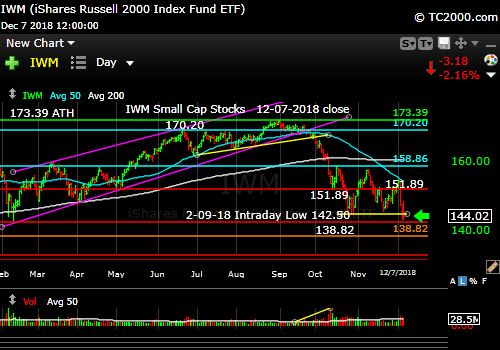
Posted in Bonds, gold, investment, investor sentiment, large cap stocks, S&P 500 Index, small cap stocks, Treasuries | Tagged , , , , , , , , , , , , , , , , , | 2 Comments